
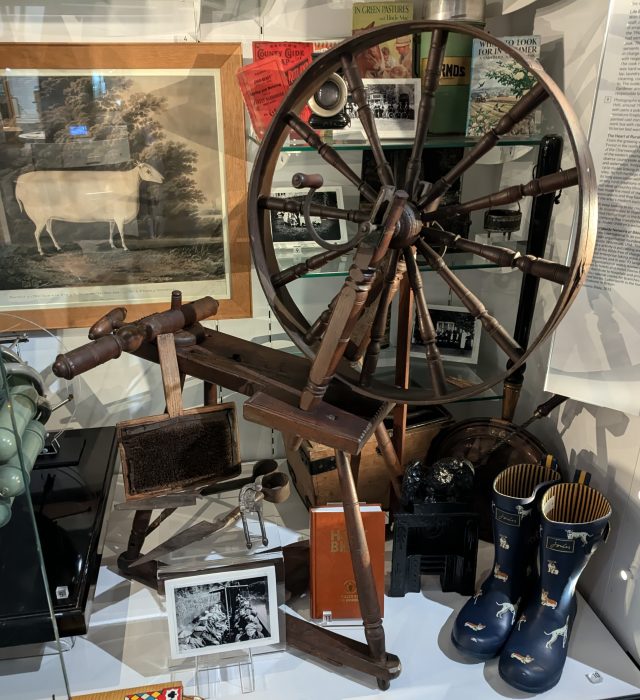
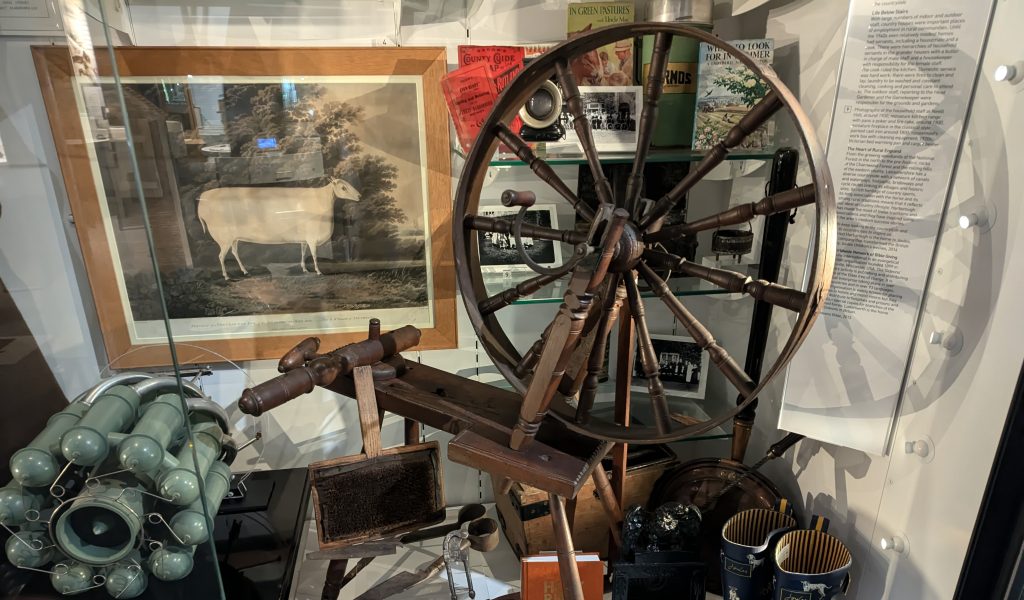
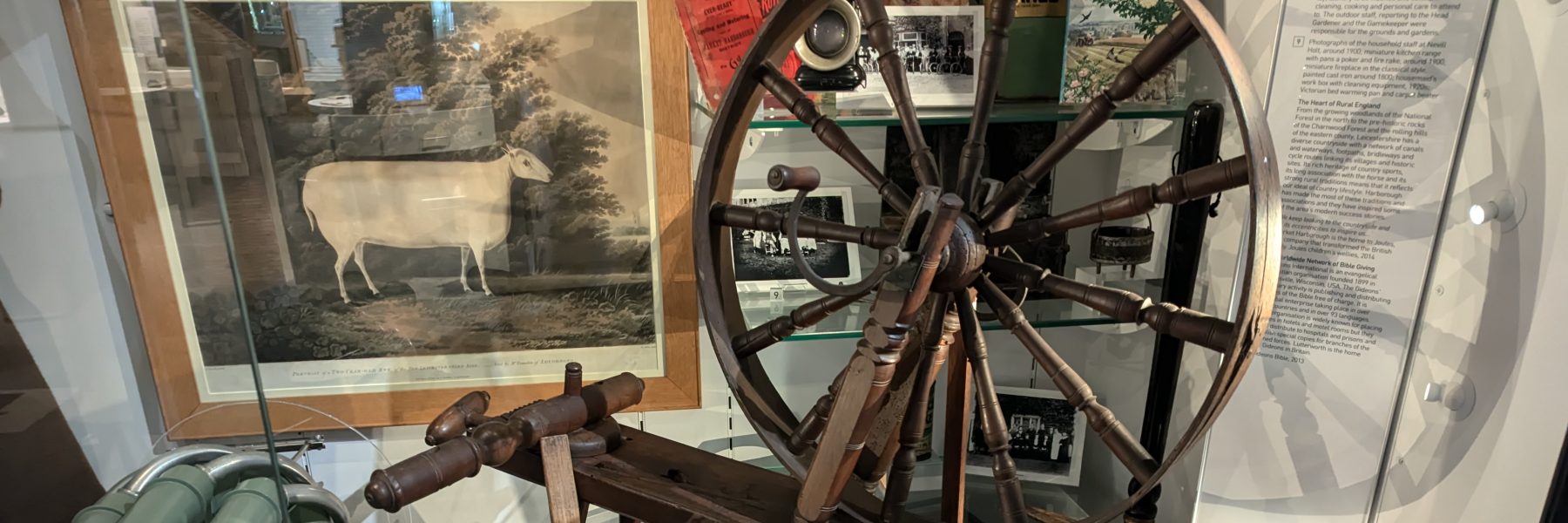
This elm spinning wheel dates to the late 18th century and is from Ashley, near Market Harborough.
Wool was a big part of Leicestershire’s industrial and agricultural landscape since the medieval period, and it was very important in the late 18th century. Britian had been known for its high-quality wool and English wool was traded across Europe. The East Midlands in particular were known for the production of ‘worsted’ wool – longer staples (fibres) of wool which create a dense, strong and smoother yarn. When the religious persecution of Protestants in Northern Europe led to many people settling in England during the 16th century, they brought with them knowledge and skills of worsted production. The sheep breeds reared in the East Midlands were ideal for this yarn due to the long fibres of their fleeces. One of these breeds was the Leicester Longwool sheep, bred by Robert Bakewell in the 1700s. Leicestershire became known for having some of the highest quality fleeces in the country and over time the Leicester knitting industry specialised in the production of worsted products.
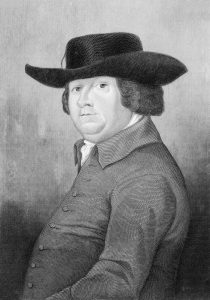
Robert Bakewell. By F. Engleheart, sc.; published by Joseph Rogerson, 12, Norfolk Street, Strand, August 1 1849. – http://www.britannica.com/EBchecked/topic/49554/Robert-Bakewell, Public Domain, https://commons.wikimedia.org/w/index.php?curid=10435129
Wool Production
The spinning of wool dates back to the stone age and English wool developed a reputation for being high quality. Before this people had to discover taking the fleece from a sheep to creating a thread that could be woven into cloth. Raw fleece from a sheep first needs to be washed, then carded (brushed). The most significant development was the drop spindle. Drop spindles can be incredibly simple, looking like a thin, cylindrical length of wood, with a weight and hook on one end. They work by drafting (pulling out) a section of the wool, spinning and dropping the spindle to allow the yarn to twist itself using the momentum from the spin and gravity. On a microscopic level, this happens due to the fibres having little hooks on them. When twisted together, these hooks lock a little bit like Velcro and this is what creates the yarn. Depending on the thickness you want, you can then ply it, which means spinning it back on itself in the opposite direction so the two threads wrap around each other. Then you can get knitting! The drop spindle was easy to create and easy to use, although time consuming to produce large quantities of yarn.
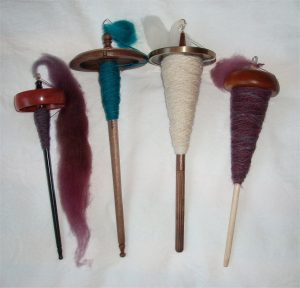
Modern drop spindles. Image credit: Pschemp, CC BY-SA 3.0 <https://creativecommons.org/licenses/by-sa/3.0>, via Wikimedia Commons
The spinning wheel was probably invented between 500 and 1000AD, and it arrived in Europe by the 13th century. They would have been hand-cranked with a wheel, much like older sewing machines, before the invention of the foot-treadle spinning wheel in the 17th century. The foot-treadle spinning wheels, like this one from Ashley, were much more efficient and the domestic textile industry relied heavily upon them. The spinning wheels themselves were works of craftmanship and were often made by specialist wheelwrights. Over the course of the Industrial Revolution, spinning became mechanized and, by the early 1800s, large textile mills massively outnumbered domestic spinning. Today, the craft of making spinning wheels themselves has been highlighted by the Heritage Craft Organisation as critically endangered, with only two professional craftspeople continuing to make them in the British Isles.
Market Harborough and Spinning
Market Harborough itself has an interesting relationship to the wool industry, with evidence of wool trading from the 14th century onwards. While the Square was formerly the Sheep Market, placing wool figuratively and geographically at the centre of the town, there was also resistance to developments in the industry. Until 1788, wool fibres needed to be left in oil for a year after combing in order to strengthen them prior to spinning. Innovators had attempted to improve cotton spinning machines using rollers to spin several yarns at once, but this was not always reliable as the quality of the yarn suffered and it needed a reliable source of power, such as a mill. In 1788, however, Brookhouse from Melton Mowbray used this principle of spinning yarn with rollers with the locally produced and stronger worsted wool, which meant that the wool could be spun without waiting a year for the fibres to strengthen first.
In the 18th century, framework knitters and other workers in the “clothes making belt” of the East Midlands largely worked on a small scale from home – the production of wool and cloth was primarily a cottage industry. The introduction of new technologies in textile manufacture therefore threatened the livelihoods of many of these cottage workers and the result of this was the Luddite protests of the late 18th century. The mythical Ned Ludd, supposed originator of the machine-smashing-trend, was supposed to be from Anstey, north-west of Leicester. Consequently, as Brookhouse began to make moves to partner with other worsted spinners, workers in Leicestershire felt threatened by this new technology and protested against the machine. In order to protect the technology until the rioting had died down, Brookhouse moved his machine from Leicester to Market Harborough. However, rioters found the machine and destroyed it, carrying the broken pieces back to Leicester in a parade of anger. So, while this spinning machine might look simple and homely, spinning machines from Market Harborough in fact have quite a knotty history!
By Anna Fraser, Harborough Museum Local Studies Research Volunteer
References:
Bowles, Geoffrey & Kirranne, Siobhan, Knitting Together: Memories of Leicestershire’s Hosiery Industry (Leicester: Leicestershire Museums Publication, 1990)
British History Online, ‘Market Harborough’ ([https://www.british-history.ac.uk/vch/leics/vol5/pp133-153] accessed 16/03/2026]
Discover Charnwood, ‘Textile Industry’ ([https://www.discovercharnwood.co.uk/textile-industry] accessed 16/03/2026)
Henson, Gravenor, Henson’s History of the Framework Knitters (1831) (Newton Abbot: Redwood Press Limited, 1970)
Heritage Crafts, ‘Spinning Wheel Making’, ([https://heritagecrafts.org.uk/craft/spinning-wheel-making/] accessed 16/03/2026)
Knitting Together: The Heritage of the East Midlands Knitting Industry, ‘Worsted Innovations, ([https://www.knittingtogether.org.uk/industry-timeline/enterprise-and-innovation-1750-1810/worsted-innovations/] accessed 16/03/2026)
Seymour, John, The Forgotten Arts: A Practical Guide to Traditional Skills (London: Dorling Kindersley Limited, 1984)
Walk Midlands, ‘Leicester – Anstey’, ([https://walkmidlands.co.uk/2022/11/24/leicester-anstey/#google_vignette] accessed 16/03/2026)
Wymer, Norman, English Town Crafts (Wakefield: EP Publishing, 1975)
You may also be interested in
Other popular posts
The Harborough Toys
Rare 17th century wood and bone toys uncovered at the church of St Dionysius.
The Hallaton Helmet by Francesco Galluccio
The amazing replica Roman helmet created for Harborough Museum
Heritage Open Days
We've been giving people a look at unseen areas of The Symington Building