
Vere Caldwell
Whilst searching the St. Nicholas Churchyard in Little Bowden I was intrigued by the gravestone of Vere Caldwell, Esq. He was a Captain in the 90th Regiment of Light Infantry who died on April 8th 1840, aged 29 years old. My first thought was why was a relatively young army officer buried in a civilian churchyard? Further research revealed an interesting and gruesome story.
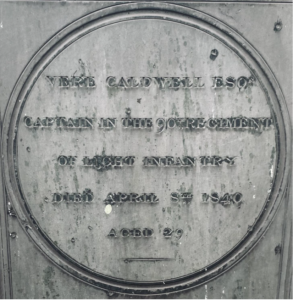
The gravestone of Vere Cladwell in Little Bowden churchyard
Vere Caldwell was born in the Manor House at Hilborough, also known as Hilburgh, in the county of Norfolk on January 24th, 1811. His parents were Ralf Caldwell, Esq and his wife Louisa Isham, who was a member of the Isham family of Lamport Hall, Northamptonshire.
Vere Caldwell had a brother named George, born in 1806. This made Vere what is now commonly referred to as the ‘spare to the heir’ and he joined the military rather than the Clergy or Royal Navy in 1828, aged 17 years old.
Vere Caldwell joined the 90th Regiment of Light Infantry (Perthshire Volunteers) as an Ensign, the lowest rank of Commissioned Officer. His family paid for his commission and it would probably have cost £450, the equivalent to £42,549 in September 2025.
The Gentleman’s Magazine (Volx111 New Series, 1840) records the event and adds he was promoted, possibly through payment, to Lieutenant in 1832 and then Captain in February 1840.
In April 1840 Vere Caldwell was staying with the family of his cousin, Hannah Brown, in Little Bowden.
On April 8th, the captain had ridden out to Brixworth Hall with Mr. Brown to attend a party. On their return to Little Bowden they stopped off at Lamport Hall, owned by his uncle Sir Justinian Isham. Various versions exist of what happened next. One version of the story is that through the influence of alcohol, a joke should be played on Sir Justinian Isham, by painting red the swans that surmount the columns of the gateway. Another version states that the captain attempted to displace one of the swans (which were made of iron and weighed up to 100 kilos), missed his footing and fell, grabbing the swan.
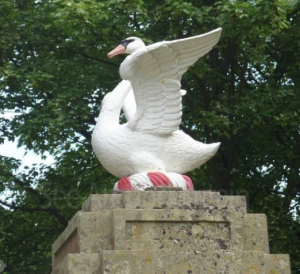
Lamport Hall Swans. Source: Around Britain Magazine
The swan’s beak pierced his chest as it fell on him. As the nearest doctor lived in Little Bowden, some 8.5 miles, the captain was removed to Little Bowden by carriage. One story states as there was snow on the ground a trail of blood could be seen all the way to Harborough!
Unfortunately, the captain died that night and was buried on April 13th in the Little Bowden Churchyard. Why he is not buried at the family home, in Norfolk is unknown.
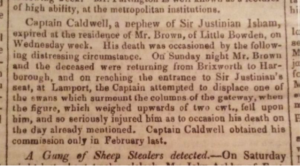
Report from The Northampton Mercury of 18th April 1840
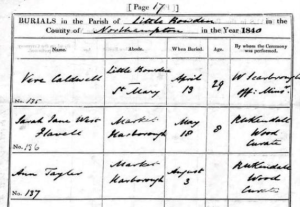
Little Bowden Parish Burials from 1840 – Northamptonshire Records
By Anthony Cherrington, Local Studies Research Volunteer, Harborough Museum
You may also be interested in
Other popular posts
The Harborough Toys
Rare 17th century wood and bone toys uncovered at the church of St Dionysius.
The Hallaton Helmet by Francesco Galluccio
The amazing replica Roman helmet created for Harborough Museum
Heritage Open Days
We've been giving people a look at unseen areas of The Symington Building