
The British Prime Minister Henry Addington declared war on France on May 18th, 1803, ending the 1802 Treaty of Amiens after just 14 months of peace. Napoleon Bonaparte planned a large land invasion of Britain in response. This was to be financed by the Louisiana Purchase of 1803, when France ceded her huge North American territories to the United States in return for a payment of 50 million French Francs (roughly about $11,250,000).
The United States had partly funded the purchase by means of a loan from Baring Brothers of London, which essentially meant that a British bank was indirectly funding an invasion of their own country!
During 1803 and 1804, a French invasion was immediately expected. This fear of invasion was captured by political cartoonists.
In response to this threat the British Government called for volunteer infantry regiments to be raised. The Lord Lieutenant of Leicestershire, His Grace the Duke of Rutland was in command of the Leicestershire volunteer force, however companies of voluntary soldiers were organised at local level.
On August 18th a public meeting was held in the Market Harborough parish church, St. Dionysius, and it was decided that the town establish the ‘Loyal Harborough Volunteer ‘ Infantry. This was to comprise of two companies of infantry which had a small band of drums and fifes (a small, high pitched flute usually made of wood).
Volunteers had to be aged between 17 and 55 years and they had to be vetted by a committee.
William French Major, Esq. was appointed Captain Commandant of the First Company, with Wiliam Atkins, Lieutenant and Thomas Green, Ensign. The Second Company was to be commanded by Pointz Owsley Heygate, Charles Heygate, Lieutenant, and John Chater, Ensign. A full history of each company is given in William Harrod’s publication of 1808, The History of Market Harborough, in Leicestershire and Its Vicinity.
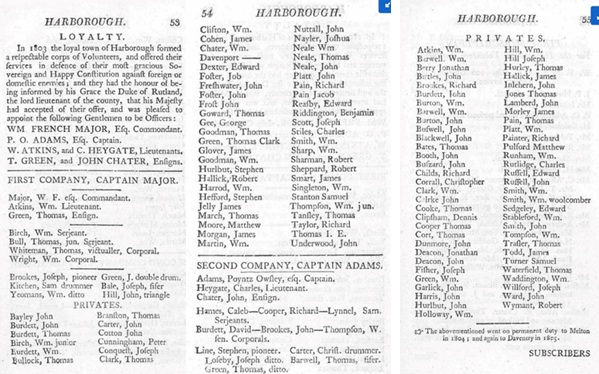
A history of companies, from William Harrod’s publication of 1808, The History of Market Harborough, in Leicestershire and Its Vicinity.
Officers and privates attended a theatre in the Town Hall on September 24th, 1803, where songs were sung ‘with the warmest of loyalty and patriotism’. The Companies received their Colours (regimental flags) at a ceremony on February 13th 1804, and later that year they were on ‘active duty’ in Melton Mowbray and in 1805 at Daventry.
Uniforms of the Harborough Loyals
In 1803, the Loyal Harborough Volunteers wore a uniform typical of British volunteer corps of the period. Specific documentation on their exact dress is limited, but from records held by the Leicestershire Yeomanry, a likely description of uniforms can be based on regional patterns and surviving descriptions of similar units.
Likely Uniform of a Private in the Loyal Harborough Volunteers (1803)
Coat: Scarlet red single-breasted coat, the standard for British infantry. Dark blue facings (collar, cuffs, and lapels), which were common among Leicestershire volunteer units. White turnback’s at the rear of the coat, adding contrast and formality. Buttons & Trim: Pewter buttons arranged in a single row down the front. Minimal lace or braid, reflecting the private’s rank and the unit’s volunteer status.
Headwear: A black felt bicorne hat with a white plume or cockade was prevalent at the time before a Shako was probably adopted later.
Trousers: Grey or white breeches tucked into black gaiters.
Accoutrements: White cross-belt supporting a cartridge box. Brown leather waistbelt with bayonet frog. Muskets issued were likely Brown Bess-style flintlocks.
Insignia: The unit may have worn a regimental badge or motto, though no specific emblem is recorded for the Loyal Harborough Volunteers.
This uniform would have been worn during drills, parades, and local defence duties.
Likely Uniform of an Officer in the Loyal Harborough Volunteers (1803)
Jacket: Scarlet red double-breasted with two rows of eight regimental buttons. It had a short tails coat, Facings: The standing collar, pointed cuffs, and turn – backs (the lining colour of the tails) were of royal blue cloth. White turnback’s at the rear of the coat, adding contrast and formality. Buttons & Trim: Silver buttons were used on the front and tails. Lining: The interior of the coatee was lined with white silk. Lace: Silver lace was used for trim and decoration. On the back of the tails, there was a silver bullion twist cord ‘waterfall’ ornament. A specific pattern of silver lace, called ‘Denmark’ was used from 1803.
Headwear: An officer would have worn a leather helmet on duty and a blue forage cap with silver lace when in undress or off duty.
Trousers: White breeches tucked into black or brown boots.
Cloak: A blue cloak lined with scarlet and having a scarlet collar.
Accessories: A sword belt and pouch, possibly with silver fittings.
Loyal Harborough Volunteers Drummer Boy Uniform 1806
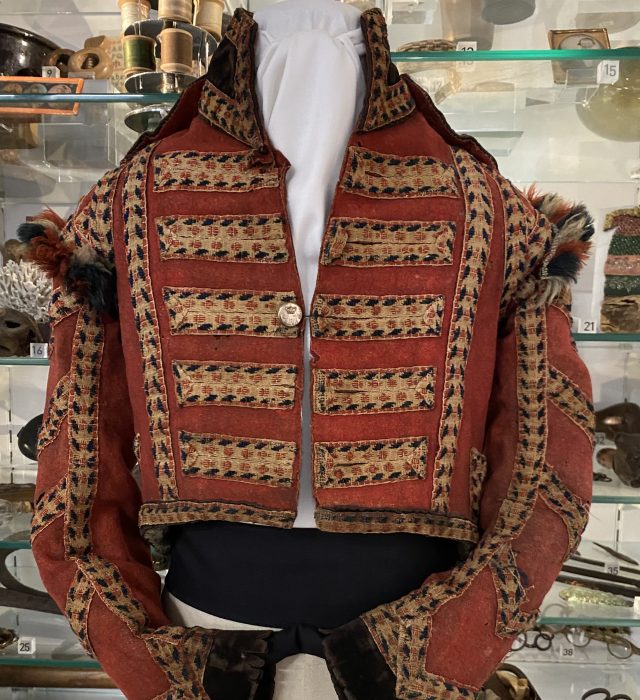
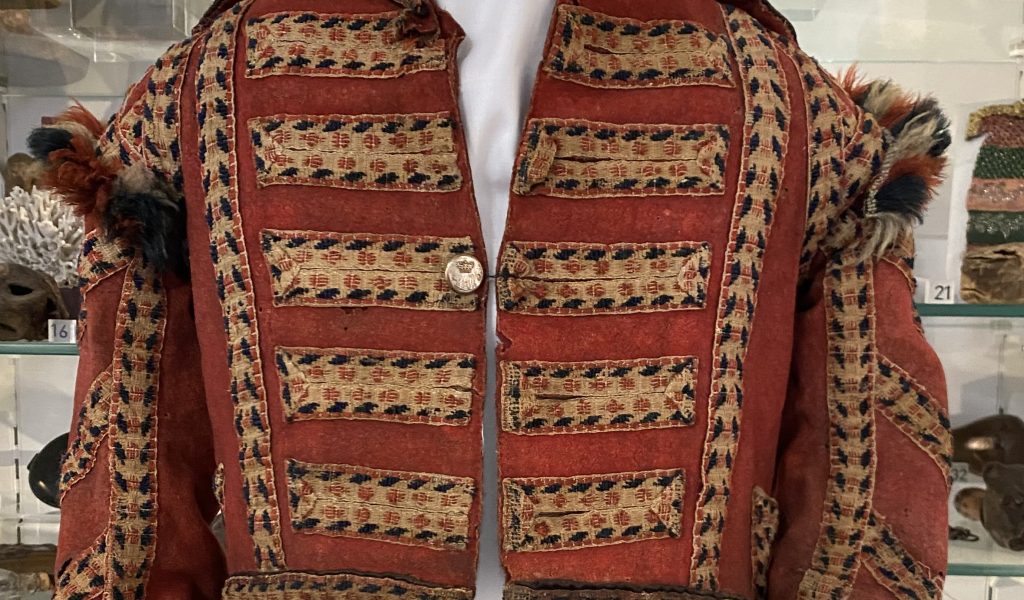
The Loyal Harborough Volunteers drummer boy uniform from 1806 is a rare and evocative example of early 19th-century British volunteer military dress. A surviving example of this uniform is on display at the Harborough Museum, making it one of the few documented artifacts from this local corps.
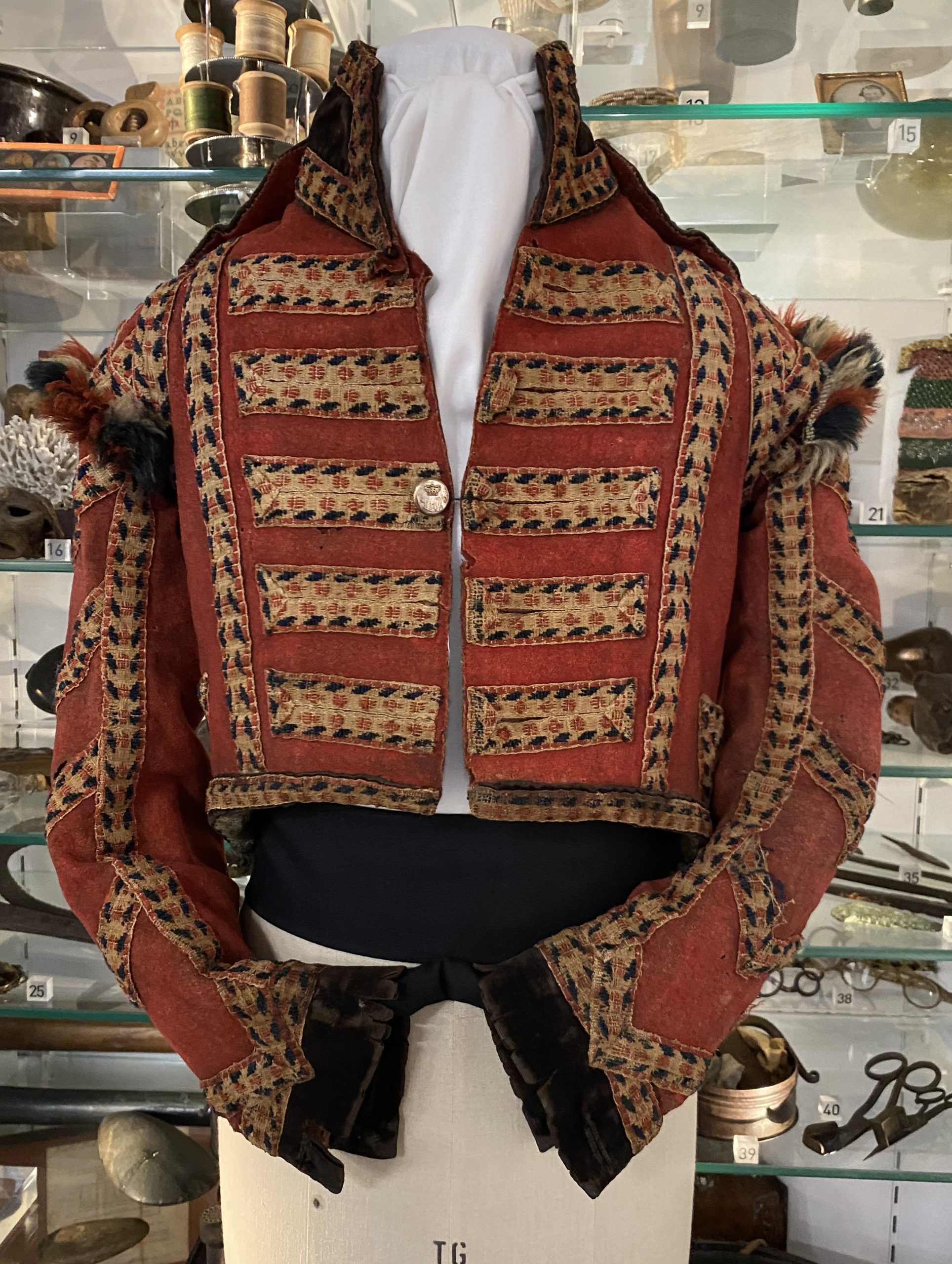
The drummer boy uniform.
Drummer uniforms were often more ornate than those of privates to make them easily visible on the battlefield. It was normal military practise in the early 19th century to recruit boys as drummers. This was important as they learned how to use drum rhythms and beats to signal officer’s commands and were used as a rallying point.
Coat: Scarlet red jacket, consistent with British infantry tradition.
Dark blue facings (collar and cuffs), matching the unit’s standard colours. This has decorative chevrons on the sleeves and chest, typical of drummer uniforms to distinguish them from regular privates.
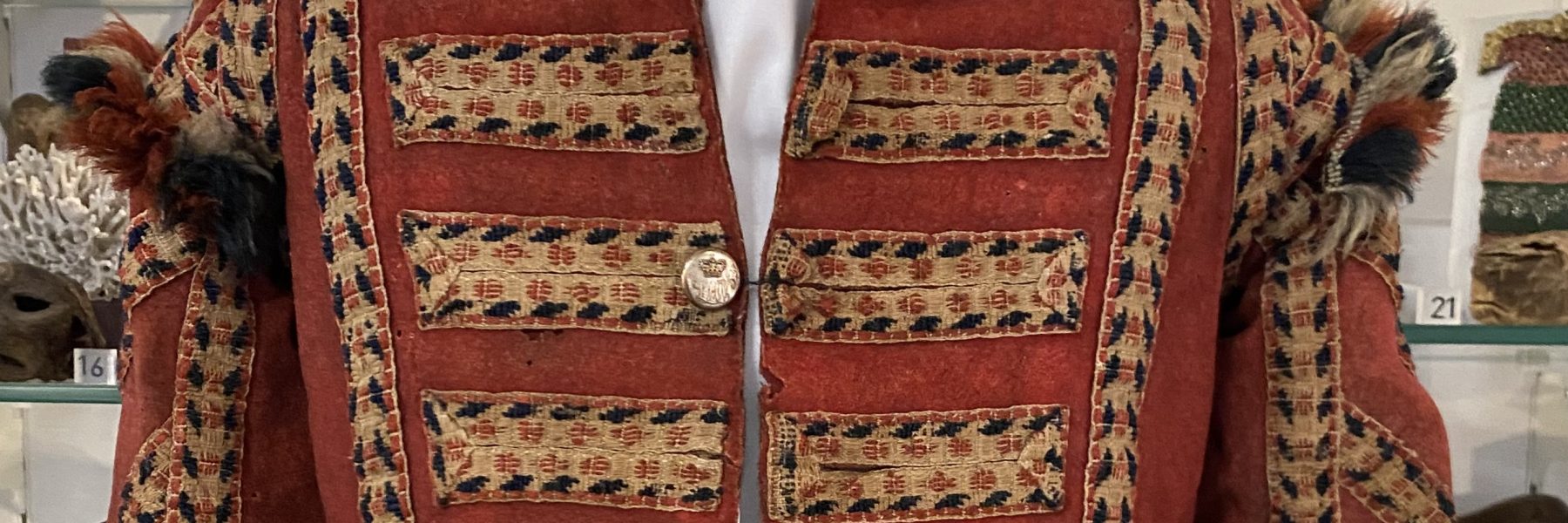
Trim and Buttons: White or silver lace trim, often in chevron or looped patterns. Pewter buttons, arranged in a single style, see below.
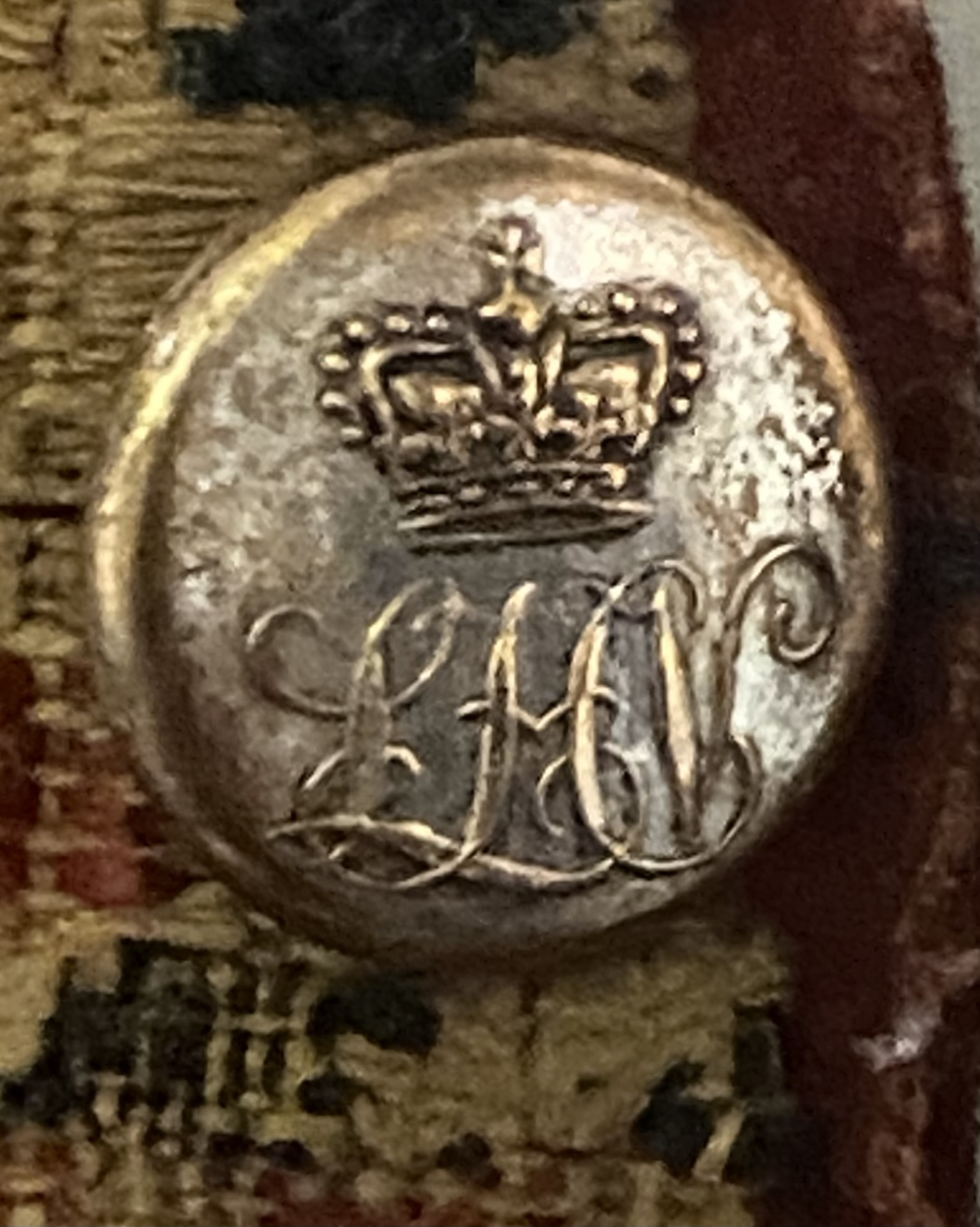
Pewter button on the drummer boy uniform, decorated with the letters LHV (Loyal Harborough Volunteers) surmounted by a crown.
Headgear: Possibly a black bicorne hat with a white plume or cockade. Some drummer boys wore shakos later in the period, but bicornes were still common in 1806.
Trousers: Possibly Grey breeches or trousers, tucked into black gaiters. Drummer boys sometimes wore shorter jackets or coatees for ease of movement.
Accoutrements: A white cross-belt supporting a small drum which was slung from the shoulder. The drum has the Leicestershire blue rim and the Lion and Unicorn crest and the Honi soit qui mal y pense motto, which means “shamed be who thinks evil of it”.
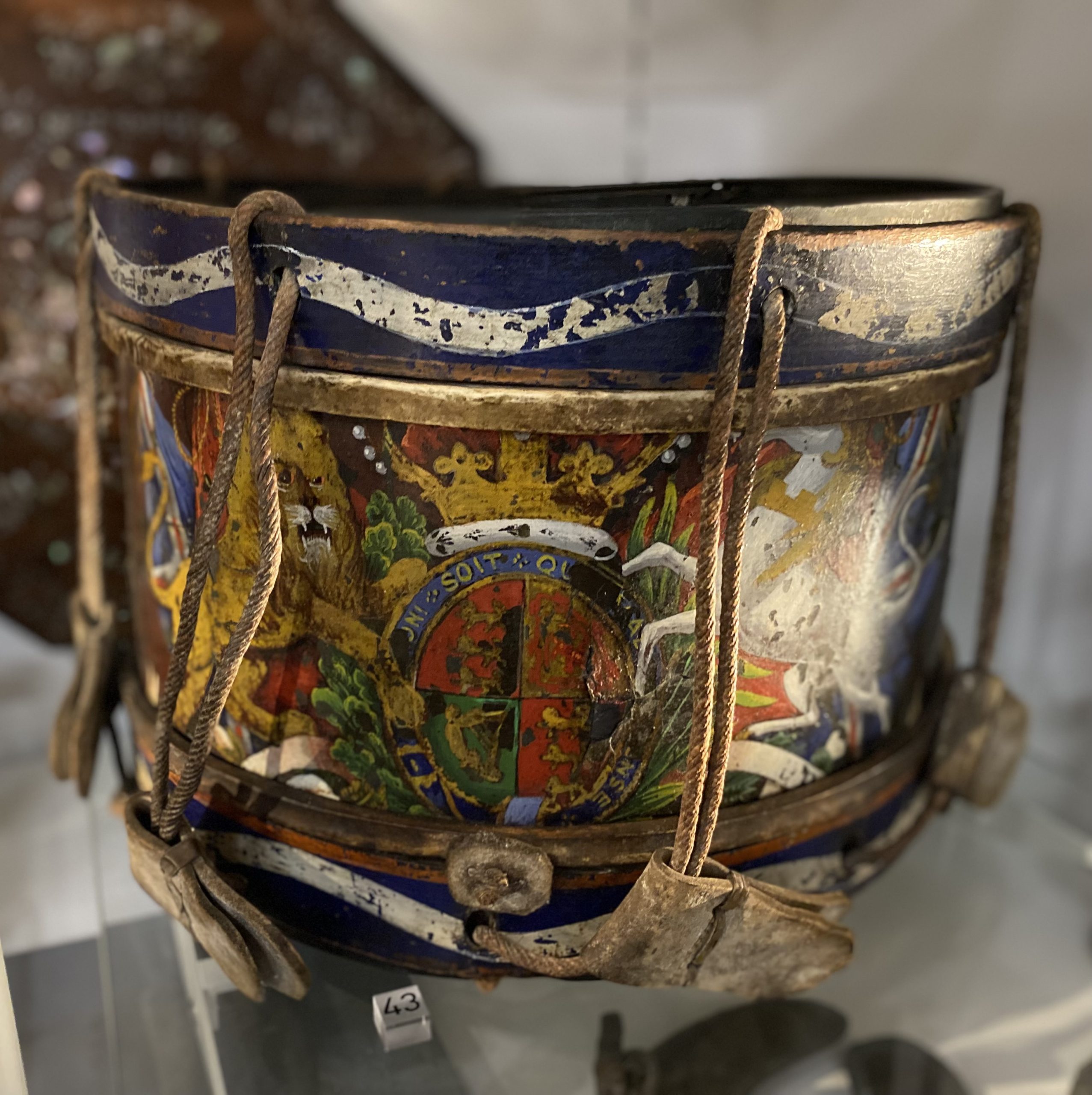
The drum, with lion and unicorn crest and Honi soit qui pal y pense motto.
By 1805, due to the naval victory of the Battle of Trafalgar, the threat of invasion was minimised, but like most British Volunteer Corps infantry and artillery units of the Napoleonic era, they were officially disbanded in 1813.
In 1808 -1809, most volunteer infantry companies were converted into regiments of the Local Militia. However, the volunteer tradition in Market Harborough continued, eventually leading to the formation of E Company, 1/5th battalion, Leicestershire Regiment of the Territorial Force in 1908, which was mobilized in August 1914 at the start of World War I.
Original text by Michael Hitchcox with supplementary text by Anthony Cherrington.
You may also be interested in
Other popular posts
The Harborough Toys
Rare 17th century wood and bone toys uncovered at the church of St Dionysius.
The Hallaton Helmet by Francesco Galluccio
The amazing replica Roman helmet created for Harborough Museum
Harborough at Work
Find out about our excellent exhibition 'Harborough at Work' and one of the amazing objects featured