
Harborough’s 20th Century Boxing Heritage
On display at Harborough Museum are a small number of items: gloves, training weights, photos and programmes, that highlight the rich association the area boasts with boxing, both professional and amateur.
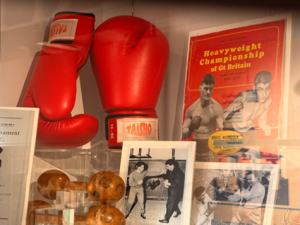
Objects associated with boxing on display in Harborough Museum
Three names stand out amongst a long list of professional and amateur boxers who came from or settled in and around Market Harborough: Reggie Meen, Jack Gardner and George Aldridge.
Reggie Meen, was born in Southam Warwickshire in 1907. By 1921 he was living at Upper Green Place, Great Bowden and employed, aged 13, at Dawbarn & Co. Tannery in Market Harborough His potential as a boxer was spotted when he was an apprentice carpenter at the Caxton Type Works in Harborough, where fellow carpenter, James Panter, started training him and set up a gym in Desborough.
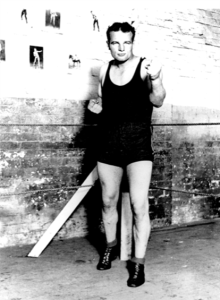
Reggie Meen. Image: Leicestershire County Council collection MH1.1993.138.
Meen boxed professionally from 1927 to 1939. He became the British Heavyweight Champion in 1931 defeating Charlie Smith on a points decision at Leicester’s Granby Halls, later losing the title to Jack Petersen in 1932 by a knock out.
Meen continued to fight on a monthly basis but never fully recovered his confidence after the defeat to Petersen and ended his career in 1939.
Out of 102 professional fights he won 57, 48 of which were by knockouts.
He also tried his hand at all-in wrestling, making his debut in 1935 where 6,000 fans saw his first fight at the Granby Halls, Leicester, winning by a knock out. Adding to the occasion 600 fans stormed the turnstiles trying to get in and the police had to be called to restore order. The referee was also knocked out during the tournament and was counted out by the crowd.
He is reported as saying at the time that he was finished with boxing and now wanted to become the British heavyweight all-in wrestling champion, an ambition he didn’t achieve.
In 1952 he emigrated to Canada where he died in 1984.
Jack Gardner was born in Market Harborough in 1926 and was brought up in Cross Street before moving to The George pub in Great Oxenden where his father was landlord.
During his time in the Grenadier Guards from 1943-48 he boxed as an amateur, winning the Army and Imperial Services Heavyweight titles as well as the British Amateur Heavyweight title in 1948. In the same year he represented Great Britain at the London Olympics, losing to a Swiss boxer.
Gardner turned professional later in 1948, becoming British and British Empire Heavyweight Champion in 1950 after defeating Yorkshire’s Bruce Woodcock in November 1950. He later became European Heavyweight Champion in 1951.
He had lost both titles by 1952 and retired to a life of farming in West Langton. Jack returned to boxing in 1954 in order to pay off a large tax demand, and won his comeback fight against Johnny Williams whom he’d lost his British and Empire titles to in 1952. He finally retired in 1956 after losing to the European Champion Joe Bygraves.
Often referred to as ‘film star handsome’, with his taste for fine clothing, faultless hair and designer moustache, Gardner was compared to actor Errol Flynn.
He died in 1978 from a brain tumour.
Out of 34 professional fights he won 28, 23 of which were by knockouts.
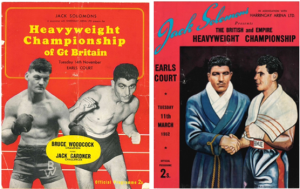
Boxing programmes in Leicestershire County Council Collection MH24.1994.20 and MH74.1994.2
George Aldridge, was born in London in 1936 but was evacuated with his family during the Second World War to Market Harborough where he became a member of the Market Harborough Amateur Boxing Club. He turned professional in 1956 and won the Midlands and Southern Area Middleweight titles between 1959 and 1962.
Aldridge became British Middleweight champion in 1962 beating John ‘Cowboy’ McCormack after which he unsuccessfully challenged for the European title. In 1963 he lost his British title to Mick Leahy and immediately retired from boxing.
From 1963 to 1988 he was landlord of the Talbot pub (where Hotel Chocolat now stands) and the Cherry Tree on Coventry Road (demolished).
Out of 52 professional fights he won 36, 17 of which were by knockouts.
Two other notable boxers who were drawn to the area by Reggie Meen’s gym in Desborough were:
Larry Gains born in Toronto, Canada in 1901, moved to Desborough in 1930 and returned to Canada in 1939. Gains was one of the top heavyweights of his era but was denied the opportunity to become World Champion due to the bar on black boxers competing for the title. He instead competed for the “Coloured Heavyweight Championship of the World”, a title that he won in 1928 and 1935. The 1935 title fight was against an American, Obie Walker, and held at the Leicester Tigers ground on Welford Road in front of crowd of 12,000.
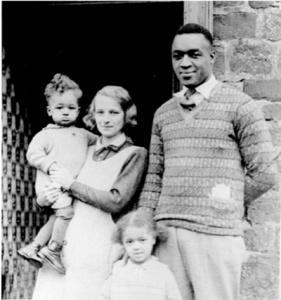
Larry Gains with his wife and children, 1930. Image: Leicestershire County Council collection MH1.1993.125.
In 1927 he became Canadian Heavyweight Champion and British Empire Heavyweight Champion in 1931, holding the title until 1934.
Out of 146 professional fights he won 118, 63 of which were by knockouts.
Ben Foord, born in Vrede South Africa in 1913 and moved to Desborough in 1934 to further his career. He was South African champion from 1934-40 and British and British Empire Heavyweight Champion 1936-37.
Out of 59 professional fights he won 40, 22 of which were by knockouts.
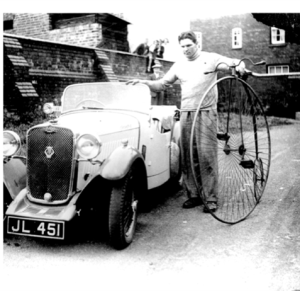
Ben Foord. Image: Leicestershire County Council collection MH1.1993.149.
Interestingly Gains beat Meens in a 1933 bout at Granby Halls, Leicester, however he later lost twice to Foord in 1935 and 1936 again at the Granby Halls.
By Michael Jack, Harborough Museum Local Studies Research Volunteer
You may also be interested in
Other popular posts
The Harborough Toys
Rare 17th century wood and bone toys uncovered at the church of St Dionysius.
The Hallaton Helmet by Francesco Galluccio
The amazing replica Roman helmet created for Harborough Museum
Heritage Open Days
We've been giving people a look at unseen areas of The Symington Building