
The Redlich Family
Over the years the Church of St. Nicholas, Little Bowden, has benefitted from Rectors who have served there for many years, but one family has incurred a legacy of talent and unfortunate tragedy.
The Revd, later Canon, Edwin Basil Redlich was one of the longest serving Rectors of St. Nicholas Church, arriving in Little Bowden in 1924, and retiring in 1954.
Born in 1878 in Colombo, Ceylon, now Sir Lanka, to an old merchant family of mixed Dutch/. British heritage. He was a brilliant academic and attended Christ’s College, Cambridge in 1899. After his graduation, Redlich travelled to KwaZulu-Natal, South Africa, becoming Mathematics Master at Pietermaritzburg College.
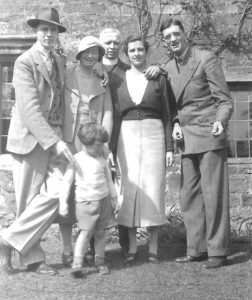
Photograph taken around 1937. From left to right Siigurd Christensen? Violet Redlich, Basil Redlich, Monica Redlich and Vivian Redlich. Patrick Redlich in the foreground.
During that time, he married Matilda in 1903, and had a son, named Vivian in January 1905.
On his return to England Redlich was ordained in 1908 at Lincoln, moving immediately to nearby Boston as a Curate. Whilst in Boston their second child was born, Monica, in July 1909.
After Boston the Redlich family moved to Hampstead, Wakefield, and Teigh near Market Overton in Rutland and then finally in 1924, they came to Little Bowden where Redlich spent the remaining 30 years of his ministry. Redlich was also appointed a Canon Theologian of Leicester Cathedral the same year.
Redlich became a prolific author of theological works; he first published in 1920 and published six more works before 1950. He was also very active within the town, one position being the first President of the Market Harborough Archaeological (now) Historical Society when it was formed in 1931.
Tragedy came to Basil Redlich in 1927 when his wife Matilda died aged only 52 years, his son Vivian was then 22 and daughter Monica was 18 years old.
In 1931 he married again to Voilet and had two sons; Patrick, born in 1932 and Peter born in 1937. Unfortunately, tragedy struck again, when Peter drowned on March 1st, 1939, in the River Jordan, which ran at the bottom of the vicarage garden.
WHO WERE THE REDLICH CHILDREN?
Vivian Frederick Barnes Redlich is probably the best known of the Redlich elder children, as during WW2 he became one the many Christian martyrs of the 20th century, and much has been written about his tragic ending.
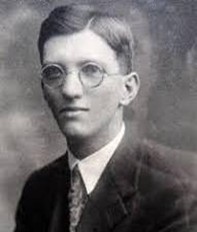
Vivian Redlich
He was born in 1905, and was educated at St Johns School, Leatherhead. This school was founded in 1851 for the education of the sons of Anglican clergy. Shortly after his mother died Vivian took time out travelling to Canada. After returning to the UK, he returned to his training for the Priesthood at Chichester and was ordained at Wakefield in 1932. He served his curacy at Dewsbury Moor, a poor mining and textile area in the industrial West Riding of Yorkshire.
What was he like? He was tall, and thin with a long face and wore large round eyeglasses. Whilst at Dewsbury he was a noted Scout Leader, known for his dynamic wit, generosity and friendly personality.
Vivian was deeply religious and decided on missionary work. In 1935 he agreed to become a ‘Bush Brother’ for five years in Queensland, Australia. A Bush Brother was a priest who promised to remain single and stay with the Brotherhood for five years, in return for bed and board. His large ‘parish’, about the size of Wales, was very scattered and remote, serving sheep stations in the outback. He reportedly travelled about in an old Ford car, and it was said that ‘what he did not know about the motorcar was not worth knowing.’
When his five years were complete, he turned down the right to return to Little Bowden, choosing to go to Papua (New Guinea) instead to work for the Church there. At first Vivian was based at Dogura and then at Gona on the coast some 150 miles away. Here he met the missionary nurse, May Hayman to whom he became engaged. In August 1941 he was sent to run the Sangara station about 30 miles inland from Gona, where he threw himself into his work.
In 1941 fighting in the Second World War mainly took place in Europe. On 7th December 1941 the destruction of the USA Fleet at Pearl Harbour, Hawaii, caused fighting to spread. In January Japan occupied the island of New Britain; and from there they harassed the Papuan coast.
Despite the Japanese invasion, and his opportunity to leave, Vivian decided to stay with his people and later in 1942 it was reported that he had been beheaded by the Japanese, and that May and a fellow nurse had also been killed. After later hearing of his son’s death, Basil Redlich gave the sermon of his life to the congregation of St. Nicholas Church.
Monica Mary Redlich was a writer of novels, non-fiction, and children’s literature. She was born in 1909 and later studied English literature at Westfield College in London, graduating in 1931, aged 22years old.
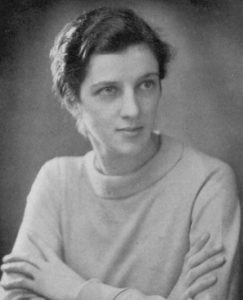
Monica Redlich
After finishing her studies, Redlich worked as a secretary for the poet, short story writer, novelist, film script writer and publisher L. A. G. Strong, With Strong she co-edited her first book Life in English literature, an Introduction for Beginners. Strong dedicated his 1935 novel The Seven Arms to Redlich. She became a popular and successful writer with five further novels using her humour and childhood memories.
In 1937 she married Siigurd Christensen, a Danish diplomat who was Danish Vice-Consul in London at the time.
In 1939, Redlich and Christensen moved to Copenhagen. Redlich published the non-fiction book Danish Delight in 1939, reflecting on her time living there. Despite the German invasion in April 1940 the couple remained in Denmark throughout the Second World War. During the Nazi occupation, Redlich taught at the University in Copenhagen as a lecturer, and also gave English lessons to the future queen, Margrethe 11.
The thought of his daughter living under Nazi occupation and her brother serving in Papua New Guinea must have weighed heavily on the minds of Basil Redlich and his wife during the Second World War.
After the war Monica Redlich returned to writing with The Pattern of England: Some Informal and Everyday Aspects and then her fourth and final novel The Various Light. She also published the non-fiction books Summer Landscape: Denmark, England, U.S.A. in 1952 and Everyday England, in 1957.
Redlich returned to being a diplomat’s wife and from 1947 to 1954, her husband served as Danish Consul in New York before returning to Europe.
The couple moved again in 1961 to Madrid. Monica died on 28 June 1965 in Madrid at the age of 55 of a heart attack. Two stained glass windows in the north porch in St Nicholas’ Church were dedicated to Redlich in 1969. In 1970. her unfinished autobiography, The Unfolding Years, was edited and published by her husband.
Patrick Redlich was the eldest son from Basil Redlich’s second marriage and was born in 1932. He was educated at Haileybury and Cambridge. After completing his National Service as an RAF pilot, he worked as a civil engineer in Asia and the Caribbean then transferred into Management Consultancy for Governments and Industry in Europe and Australasia.
Intrigued by his elder brother’s death, he was surprised to find in 2003 when a Orokaiva Tribesman admitted that members of his family had murdered Vivian Redlich and they felt cursed by this. In 2009 Patrick visited New Guinea to offer forgiveness and attend a service of reconciliation which was attended by 1500 people. Through donations given by tribesmen Patrick Redlich started raising funds for a Teacher Training College. In 2012 he published a book, ‘My Brother Vivian’, about his brother’s life and experiences, with all profits going to the College Fund.
By Anthony Cherrington, Harborough Museum Local Studies Research Volunteer
References:
Monica Redlich From Wikipedia, the free encyclopaedia.
John Gough – Rediscovering Monica Redlich’s Jam Tomorrow and Five Farthings: A London Story, 2025
Rosalind Willatts – Vivian Redlich (1905 – 1942) of Little Bowden One of the New Guinea Martyrs by Rosalind Willatts, Harborough Historian date unknown
Michael Milsom – The Little Bowden Society website
Aspects of Little Bowden – The Little Bowden Society, 2017
Patrick Redlich – My Brother Vivian, telling of his visit of reconciliation to Papua New Guinea in 2009
Ann Hathaway, Nicola Michaelwaite and the Revd. Alison IIiffe, St. Nicholas Church, Little Bowden
Furrowedmiddlebrow.blogspot.com
Church Times March 2025
You may also be interested in
Other popular posts
The Harborough Toys
Rare 17th century wood and bone toys uncovered at the church of St Dionysius.
The Hallaton Helmet by Francesco Galluccio
The amazing replica Roman helmet created for Harborough Museum
Heritage Open Days
We've been giving people a look at unseen areas of The Symington Building