
Over here! Americans, Italians, Germans and evacuees in Market Harborough in WWII
American forces based around Market Harborough
Papillon Hall, Lubenham, was requisitioned by the army and used as a billet for the 319th Airborne Artillery Glider Group of the 82nd Airborne Division of the U.S. Army.
On the evening of June 6, 1944, 16 Officers and 321 enlisted men of the 319th Field Artillery Battalion glided into Normandy, France as part of Mission Elmira. Landing 2 miles north of Sainte-Mère-Église, France at 2255 hours, these glider soldiers forged their place in the largest amphibious invasion in the history of warfare.
The Battalion landed in the German front lines which resulted in 2 officers and 15 enlisted men killed, 6 officers and 86 enlisted men wounded upon landing.
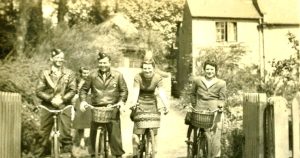
American servicemen and friends. Image source: https://319gliderman.com/stories/papillon-hall-market-harborough
Similarly Park House in Harborough was home from February to September 1944 to the 456th Parachute Artillery Battalion 82nd Airborne Division of the United States Army.
Inside the building is a plaque from veterans of the 456th Battalion which states that ‘it was from this lovely English town that our Battalion invaded Normandy and Holland’.
The 456th landed on Utah beach, France, on 8th June 1944 having sailed from Newport Wales. They returned to Market Harborough on 15th July.
Departing MH again on 15th September 1944 for Langer airfield in preparation for Operation Market. This was the air assault part of Operation Market Garden, the attempt to shorten the war by driving a wedge into Germany by crossing the bridges in Holland and the Rhine and moving into the Rhur.
They were towed in CG-4A gliders into Holland on 18th September landing at Groesbeck just south of Nijmegen. They stayed in Europe taking part in the Battle of the Bulge and the advance into Germany. They finally returned to the USA on 3rd January 1946 aboard the Queen Mary.
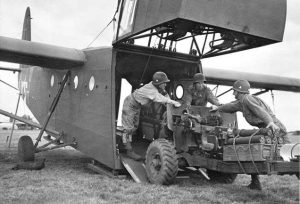
Soldiers prepare a glider. Image source: www.bhic.nl
Italian prisoners of war in Market Harborough
Known as Harrington Camp (Camp 49), the Prisoner of War camp was situated at Farndon Road, Market Harborough. It held Italian PoWs from 1942-45 and then German PoWs from 1945-48.
One Italian prisoner, named Grasso, saved a group of children from being attacked by a bull whist he was working on a farm in 1942. He attacked the bull with a fence stake and was badly gored in the process. A navel electrician by trade he used his convalescence time at Kettering Hospital repairing radio headphones that gave patients entertainment.
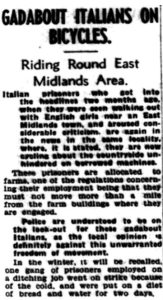
Market Harborough Advertiser and Midland Mail July 17, 1942.
German prisoners of war in Market Harborough
German prisoners of war in Market Harborough were held at Farndon Road PoW camp from 1945-1947.
They participated in the community doing farming work and in their spare time they played football against local sides, made wooden toys for the local churches to donate to children of their congregations and even presenting a puppet show of Sleeping Beauty as part of the 1947 Harvest Festival at the Congregational Church.
50 of the prisoners decided to remain in Market Harborough rather than return to Germany after they were freed.
Evacuees
In the month following the outbreak of war over 3,000 mothers, children and teachers were evacuated to the Harborough area. However, when the expected aerial bombardment of cities did not occur immediately many returned home.
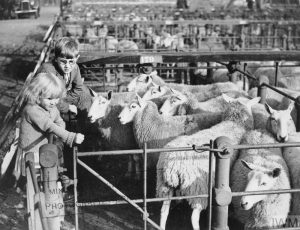
Market day at Market Harborough, Leicestershire. Two young Londoners inspect sheep in pens at the market. Image: IWM (HU 69022) https://www.iwm.org.uk/collections/item/object/205018767
The end of the war
War in Europe ended with the German surrender in May 1945 and in the Far East with Japan’s in the September. After six years of struggle and heartache Harborough celebrated. The bunting and flags came out, victory parades began and all over the town street parties were held.
By Michael Jack, Local Studies Research Volunteer
You may also be interested in
Other popular posts
The Harborough Toys
Rare 17th century wood and bone toys uncovered at the church of St Dionysius.
The Hallaton Helmet by Francesco Galluccio
The amazing replica Roman helmet created for Harborough Museum
Heritage Open Days
We've been giving people a look at unseen areas of The Symington Building