Religion and belief
Religion and belief is part of the following collections: The Harborough Collection.
Highlights
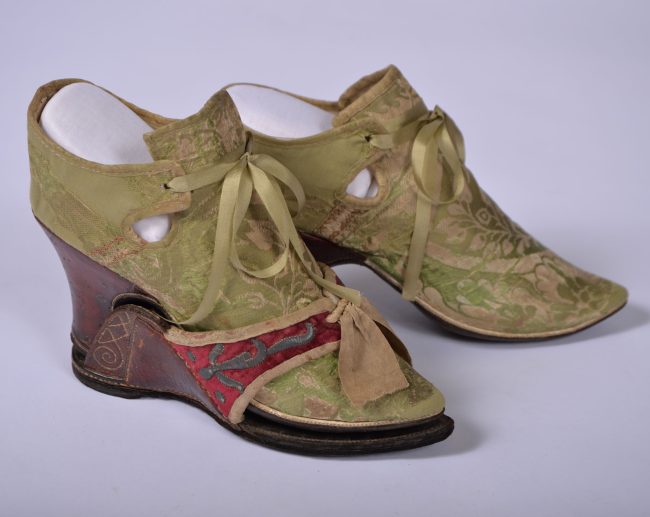

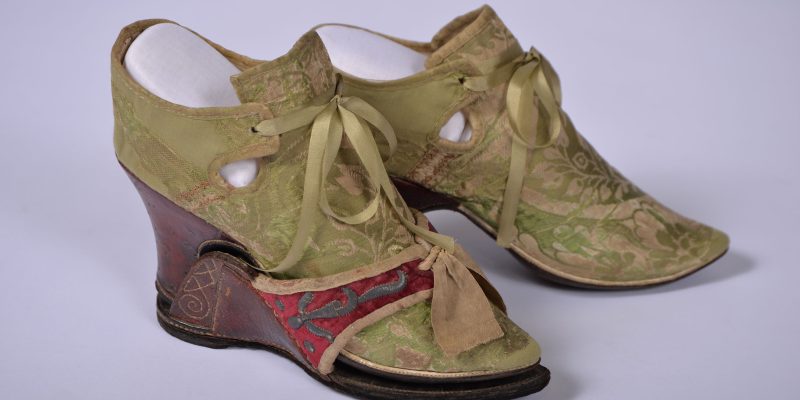
Papillon Hall shoes
The shoes from Papillon Hall were reportedly owned by the Spanish mistress of David Papillon (1691-1762), known as Old Pamp. She was kept prisoner in the attic of the house and would take her exercise on the roof of the Hall.
She died in mysterious circumstances around 1715. There was no record of her death. However in 1903 during alterations to the hall, a body was found walled up somewhere in or near Old Pamp’s Attic. It may well be that she was the owner of the shoes, upon which legend has it she left a curse that would bring death and disaster to the owner of the house if ever the shoes in which she walked were to leave the house.
During the time Thomas Holford owned the house, the shoes were sent to Paris for an exhibition. From that moment, life at the hall became intolerable with strange knockings and sounds all over the house. They endeavored to get the shoes back but could not retrieve them until the exhibition had finished, so there was nothing for it but to vacate the hall. The next owner of the hall built a small container into the wall above the Hall fireplace with a strong metal grill and a padlock, so that the shoes could be seen but not touched.
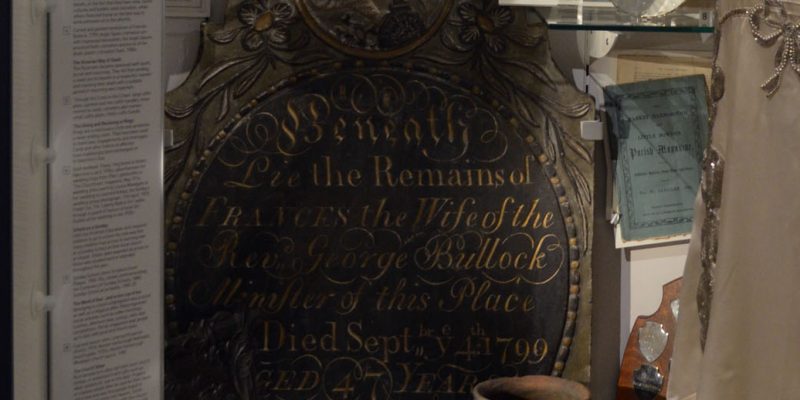
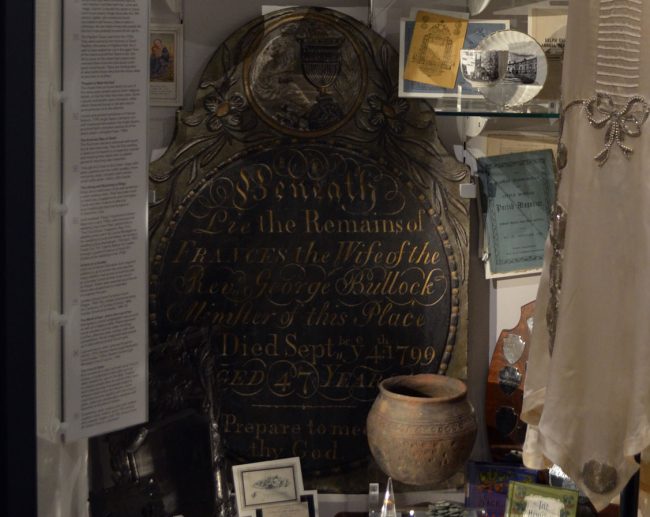
Gravestone
This beautifully ornate gravestone belonged to 47-year-old Frances Bullock, the wife of the parish reverend, George Bullock, a native of Kibworth Beauchamp. Frances was born Frances Porter in 1752. In her late-30s, Frances married George. They were married on the 26th of May 1791 at St Peter’s Church, Church Langton. Unfortunately, their marriage was short-lived as Frances died 8 years later on the 4th of September 1799. She was buried in the churchyard of All Saint’s Church, Wilbarston on the 8th of the same month. Her husband, George, went on to marry again, marrying Ann Dexter on the 20th of May 1800, 8 months after Frances’ death.

Portrait of John Wycliffe
John Wycliffe (1330-1384), whose portrait is in the ‘Religion and Belief’ case at Harborough Museum, was a leading philosopher and theologian at Oxford University.
But he was also an influential religious rebel. Believing scripture to be more important than the Pope and the Church he and his followers, the Lollards, attacked many Catholic practices. From 1374 to 1384 Wycliffe was rector of St Mary’s Church, Lutterworth, where it’s believed he produced his first Bible translation.
Wycliffe famously translated the whole Bible into English, despite opposition from the Church, making it accessible to all. But he died before the translation was finished so could not be convicted of heresy. However, the Church never forgave him and in 1428 Wycliffe’s body was exhumed, his remains burnt and the ashes strewn into Lutterworth’s River Swift.
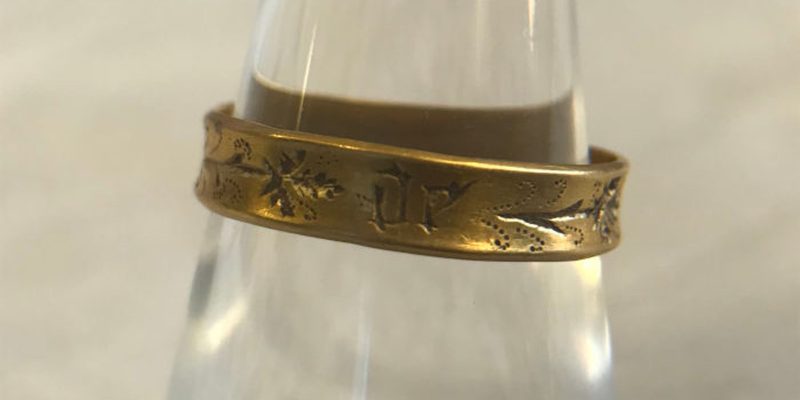
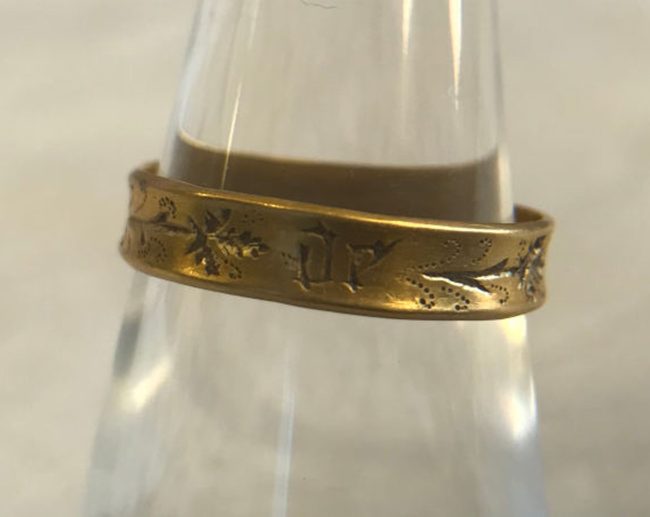
Posy ring
The Posy Ring originated in the Middle Ages, most popular during the 13th century through to 16th century. ‘Posy’ denotes a short rhyme or motto derived from the French ‘poesie’ for poetry.
The Posy Ring on display at Harborough Museum is formed with a simple gold band, engraved on the outside with a short inscription. The engraving on the ring is etched in Old French and reads ‘canc departir’, or transliterated ‘sans departir’, which is English for without parting or without division. It is thought to be an abbreviation of the saying ‘mon coeur avez sans departir’ – you have my heart without parting.
Posy Rings were given as gifts, representing love or friendship, they would contain a personalised phrase engraved in Old French, Old English or Latin. Posy rings that date before the 14th century were principally engraved in a Lombardic-style script, which was later replaced by a Gothic-style text. Many rings were also colourfully enamelled.
In medieval times when religion was a prominent part of everyday life, it was common for Posy Rings to be engraved with figures of saints or religious phrases. The ring is therefore functioning as a religious talisman.
By the 17th century, Posy Rings were more commonly plain on the outside, with an inscription on the inside. They went out of fashion by the end of the 18th century; however, it was from the simple plain gold Posy Ring that the wedding band originated.
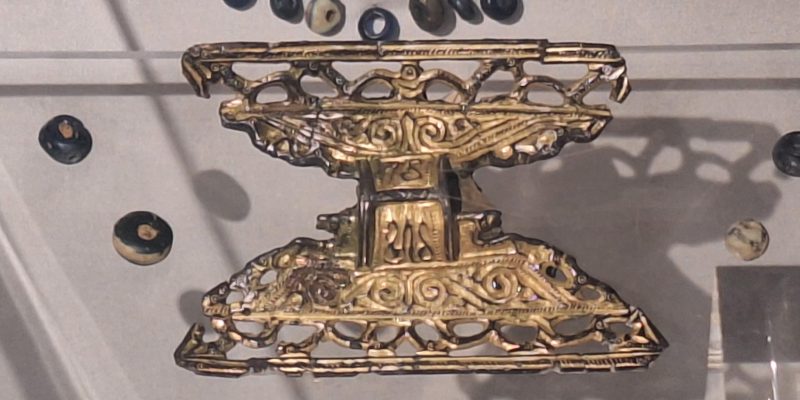
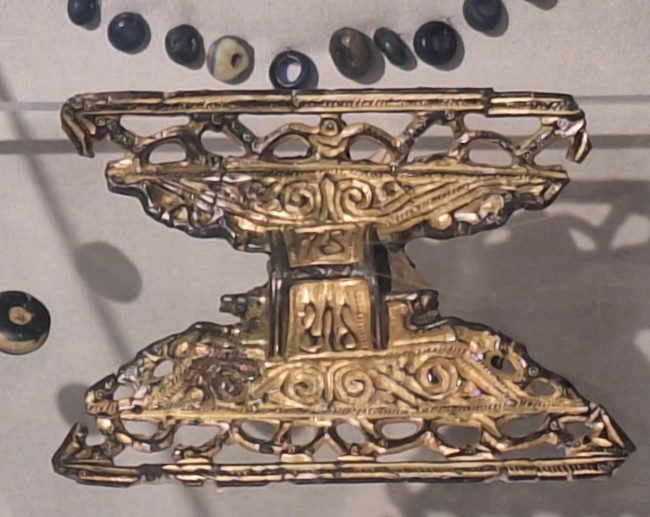
Anglo Saxon brooch
The most famous archaeology on display in Harborough Museum is the Hallaton Treasure. Another incredible discovery, aided by Channel 4’s Time Team, is the collection of Anglo-Saxon grave goods from West Langton.
A group of burials were found in 2010 and whilst the occupants had long-since collapsed to dust, a remarkable selection of possessions dating from the 6th century AD survived. Items on display at Harborough Museum include an amber and glass bead necklace, bronze cruciform brooches, and a silver-gilt equal arm brooch, hinting at high-status inhabitants in the area 1,500 years ago.
Ornate belongings such as this brooch were unearthed in a block of soil, where they were carefully excavated and x-rayed to determine their present condition. Over time the brooch had broken into 17 pieces; however, its shape and style were evident.
We know that this piece was well-loved and well-used by its owner, certain areas have worn away from human use. This is in accordance with our understanding of Anglo-Saxon traditions, it was customary for people, particularly of high importance, to be buried with their most significant possessions as it was widely believed that they would need these things in the afterlife.
The brooch was meticulously pieced back together and can now be seen in all its original glory.
Watch the Time Team Episode here: https://www.youtube.com/watch?v=Olmq4KOXaMA
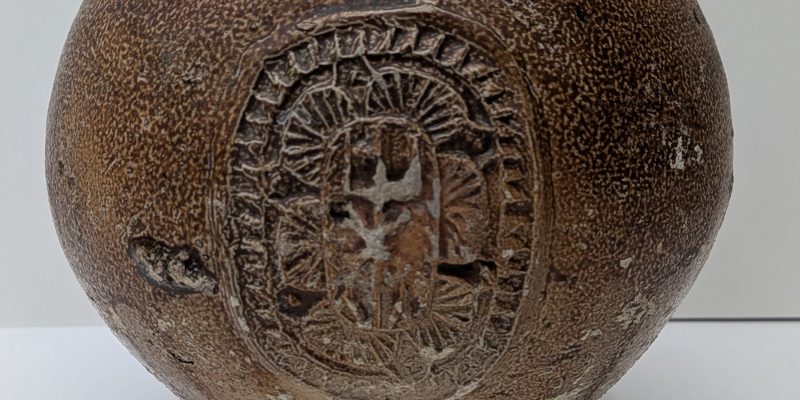
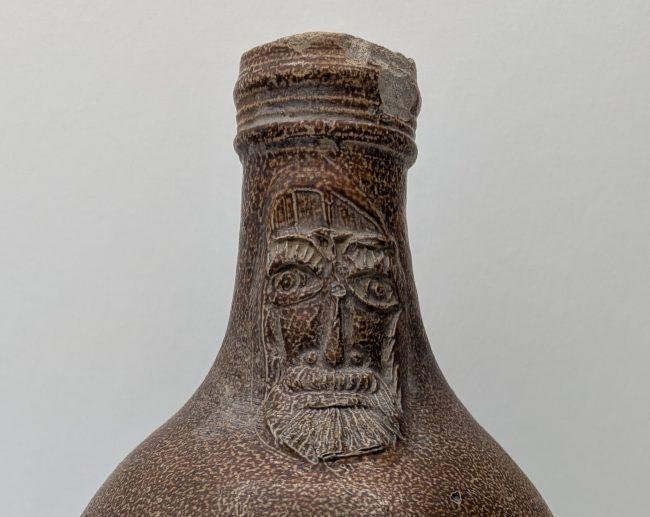
Bellarmine Jug (Witch Bottle)
A Bartmann jug (from the German meaning “bearded man”), also called a Bellarmine jug, is a type of salt-glazed stoneware pottery that was manufactured in the Rhineland around the city of Cologne, Germany, throughout the 16th and 17th centuries.
The jugs have a glossy, brown glaze with dimpled texture. This was formed by throwing salt into the kiln during firing, once it was at its highest temperature.
The jugs were named after Catholic cardinal Roberto Bellarmino (1542–1621). Protestants wanted to reform the Catholic church, but the cardinal was against this and called for alcohol to be banned. Protestant Germans cheekily drank ale and wine from jugs they nicknamed Bellarmines as the bearded man on the jug bore a resemblance to the cardinal.
The jugs were more hard wearing than British stoneware and were made in various sizes. They were used for pouring wine, storing alcohol, transporting chemicals, oils and vinegar. When filled with magical ingredients, they were used as witch bottles.
In 17th century England it was common practice to blame any poor fortune or ill health on witches. “Witch bottles” were buried under the entrance or hearth of a person’s home to ward off evil spirits. The magical ingredients could be urine, nail clippings, hair and iron nails. People believed that after being buried the bottle would capture any evil by impaling it on the nails and drowning it in the urine.
This jug was found in 2007 in Langton Brook near Smeeton Westerby.