Sickness and health
Sickness and health is part of the following collections: The Harborough Collection.
Highlights
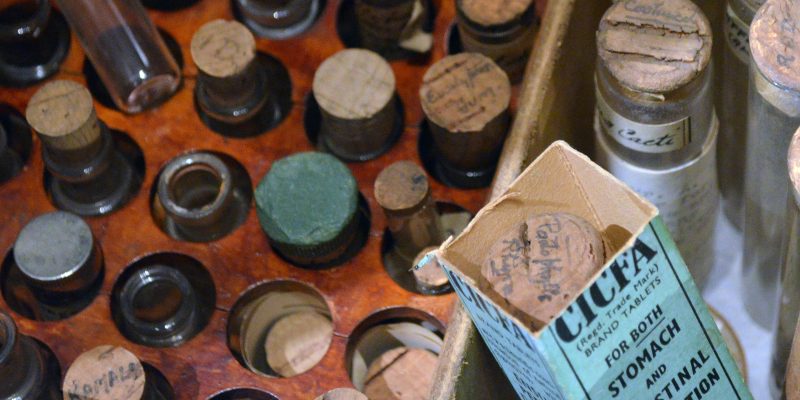
Medicine box
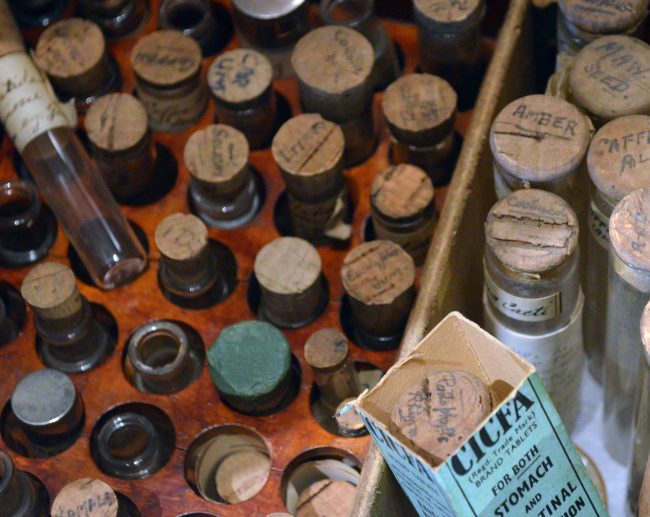
This medicine box shows many of the remedies people bought before the National Health Service, from places such as pharmacies.
William Bragg moved to Market Harborough in 1851, and had a pharmacy on Adam and Eve Street. He built Catherwood House on The Square in 1876. This building replaced a Georgian vicarage. His nephew, also William Bragg, was born in Cumberland in 1862 but when he was seven years old, his mother died and he went to live with his uncle in Market Harborough.
Sir W Bragg went to the Old Grammar School in Market Harborough, continuing onto King William’s Collage of the Isle of Man and later Trinity College, Cambridge on a scholarship. After being a professor of maths and physics at the University of Adelaide in Australia, Sir Bragg returned to Market Harborough in the early 20th century.
By 1913, Sir Bragg was working with his son, William Lawrence Bragg to find a way to examine the structure of crystals. The use of X-rays allowed them to see the structure of a diamond and in 1915 they received the Nobel Prize for X-ray crystallography. In 2015, their discovery and life in Harborough was marked with the Green Plaque on Catherwood House.
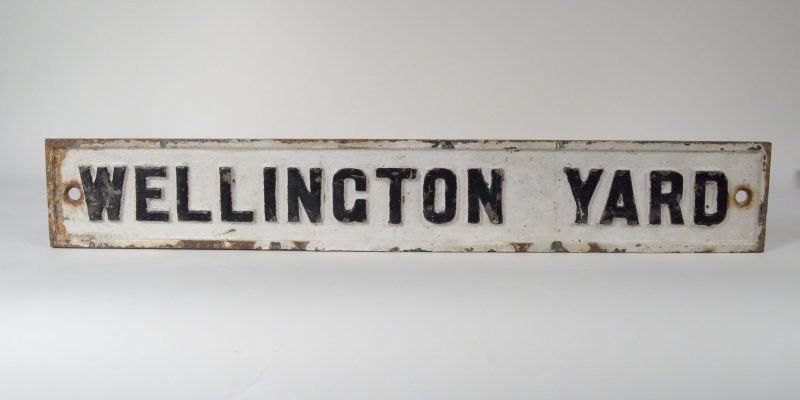
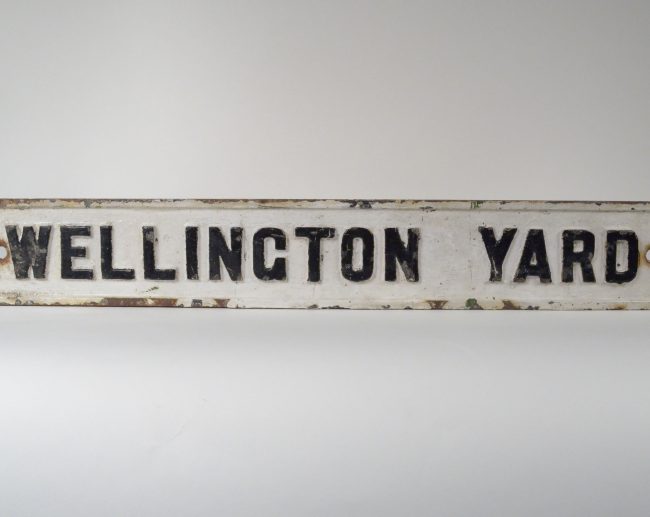
Wellington Yard sign
During the 1930s, Wellington Yard along with other yards, rows & dwellings in Market Harborough were subject to slum clearances in order to make way for newer, modern housing and better street lighting.
The local council’s house building programmes meant that in total sixty-seven dwellings in the town were cleared and a further thirty-two closed between the years of 1933 and 1938. Much of the housing, particularly in Wellington Yard just off the High Street, were no longer fit for purpose as many of the buildings were crumbling and had poor sanitation coupled with much over-crowding. The new houses and estates built after the clearings were just some of the four million built nationally between the First and Second World Wars.
One notable resident of Wellington Yard includes Corporal George Henry Waters, born in 1897 in Norwich to Charlie Henry Waters and his wife. George enlisted in the 1st Battalion Leicestershire Regiment in 1914 at the age of seventeen. Before joining the 1st Battalion, George had previously worked in Bristol as an errand boy for a grocer, whilst living with his sister and his brother-in-law who worked as a tanner glazer.
When living in Market Harborough George sought to make a living working as a shoemaker for Mr. Wright’s who occupied a premise on Coventry Road, George worked for Mr. Wright up until the outbreak of World War One. On the enlisting forms dated the 28th of August 1914, George’s recorded occupation was listed as a shoemaker and his given address listed 7 Wellington Yard, Market Harborough.
Having been awarded the Star Medal for active service between 1914 to 1915, George would continue his career in the military. Sadly, on the 15th of September 1916, nineteen-year-old George was killed during the Battle of the Somme. The Somme was one of the bloodiest battles of World War One, and it lasted for five gruelling months. In commemoration of those who fought and for those who remain missing, the Thiepval Memorial in France was commissioned. It is the biggest commonwealth memorial and is dedicated to the British and South Africans who fell. George Waters’ name is among seventy-two thousand officers and men and one of over two thousand men who served from the Leicestershire & Rutland regiments, all of whom perished. All of George’s personal effects including his medals were later passed onto his sister Mary, who is listed on George’s infantry records as also living at Wellington Yard.
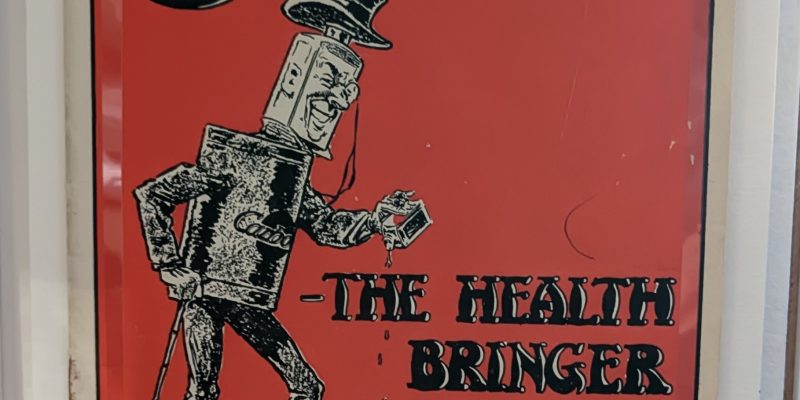
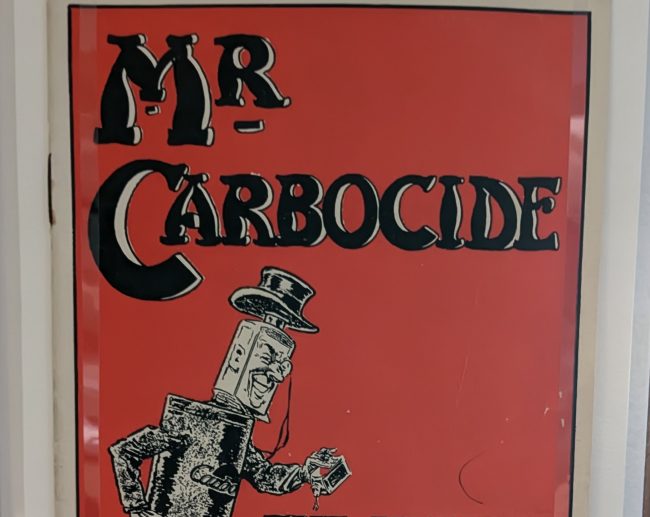
Mr Carbocide Advertisement
This advertisement shows a fictional character named Mr Carbocide- The Health Bringer, who was invented by Philadelphus Jeyes & Company Ltd. Philadelphus I and John Perrin founded the business at 6, The Drapery in Northampton in 1810. It continued under the name Philadelphus Jeyes until 1969, when it was bought and run by two national multiples in succession, and finally closed as a chemist’s shop in the mid-1980s. The company had a branch in Market Harborough and branches elsewhere in England.
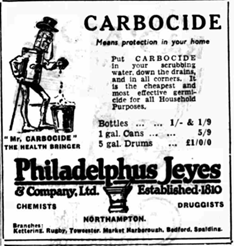
Advertisement in the newspaper: Northampton Chronicle and Echo, published on 20 July 1950.
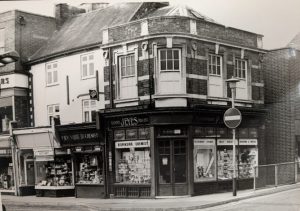
The Jeyes chemistry in Market Harborough, photo dated 8th November 1970.
Local newspaper The Northampton Chronicle and Echo featured adverts for Carbocide. According to these Carbocide was a strong cleaning product, particularly for drains and basins. The word “Carbocide” was possibly combined from the two words carbon and germicide.
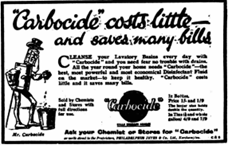
Advertisement in the newspaper: Northampton Chronicle and Echo, published in 15 August 1922.
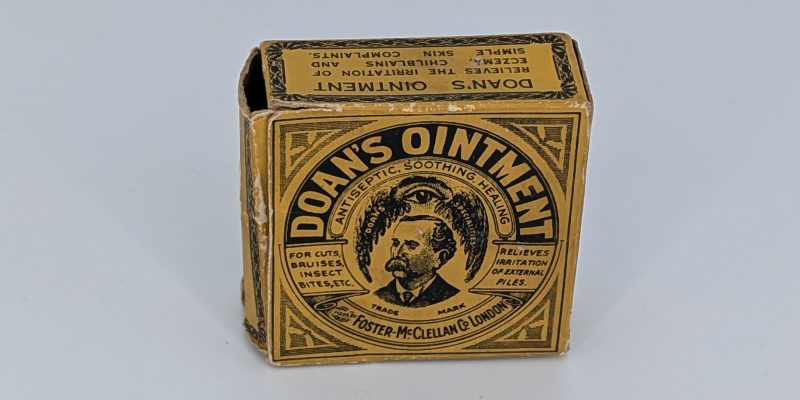
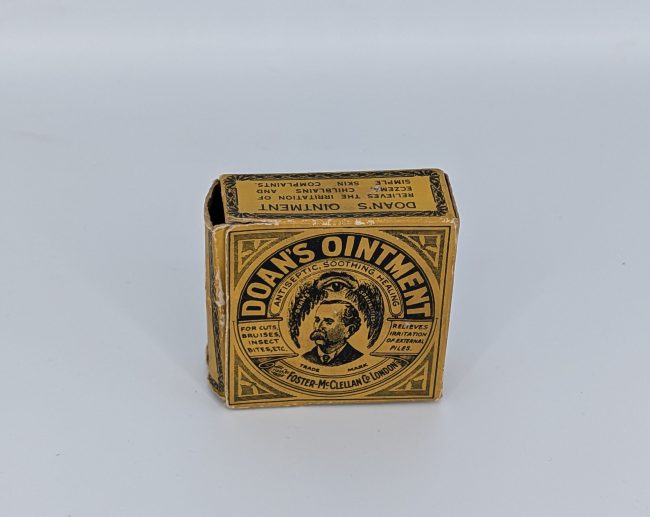
Doan's Ointment Tin
The Doan’s Ointment Tin was produced by the Foster McClellan Products Ltd, which was the London branch of Foster Milburn Company, a Canadian-founded manufacturer. Edwin McClellan founded the London branch around 1898 when he finished his university studies. Foster, McClellan Co. prospered, selling its products throughout Europe. McClellan spent most of the remainder of his life in London.
Doan’s Ointment was used for soothing and healing applications to relieve itching piles, irritation, itching skin, and to allay the itching of eczema and was widely used in the 1900s in the UK. In the 1920s, the Doan’s ointment was imported to China and was a success for the manufacturer.
The ingredients in Doan’s Ointment had around 5 % of Calomel, which was used as a medicine from the 16th to early 20th century (Davis 2000), despite frequently causing mercury poisoning in patients. The toxic potential of calomel was highlighted in 1948 when official statistics record that 585 children died of “pink disease” between 1939 and 1948. This was mercury poisoning, with a symptom being pink discolouration of the hands and feet.
Nowadays, Doan’s Ointment is still on the market but with a different appearance and a change to the ingredients. Doan’s also sells other medicines.
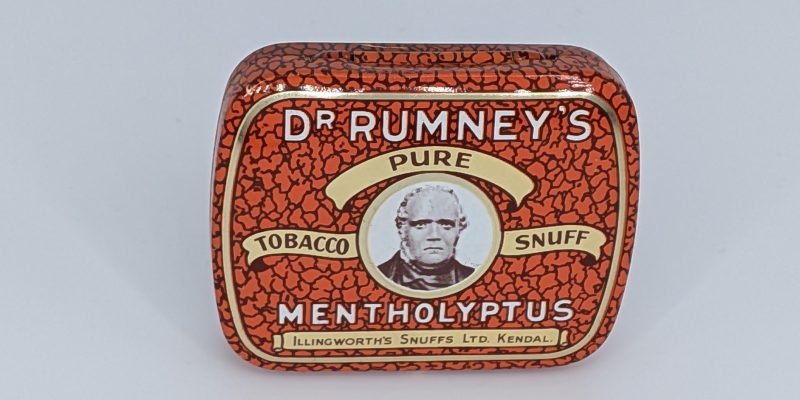
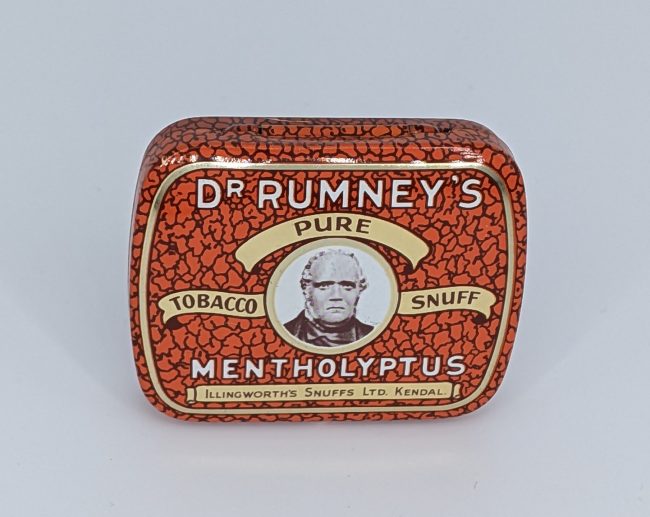
Snuff Tin
Inside this iron tin was snuff powder. Snuff was made with dried tobacco and included mentholyptus flavouring. People would put some onto their hands and sniff it for pleasure. It was also used as a medicine during the 17th century as it was thought to prevent plague.
This tin was made by Illingworth’s Snuffs Ltd., Kendal, which was founded by John Thomas Illingworth around 1867, but was closed by a serious fire in 1986. We don’t know who the person on this tin is, but Tobacco manufacturers often had the figure of a ‘Highlander’, ‘Blackamoor’, or ‘Indian Prince’.
Snuff used to be an elite fashion in the 18th century, but the industry bloomed in Kendal in the 19th century, and snuff was exported in large quantities. People could then buy it easily from an ordinary shop. Nowadays snuff is still in the vintage collecting market.