Growing up
Growing up is part of the following collections: The Harborough Collection.
Highlights



Liberty Bodice
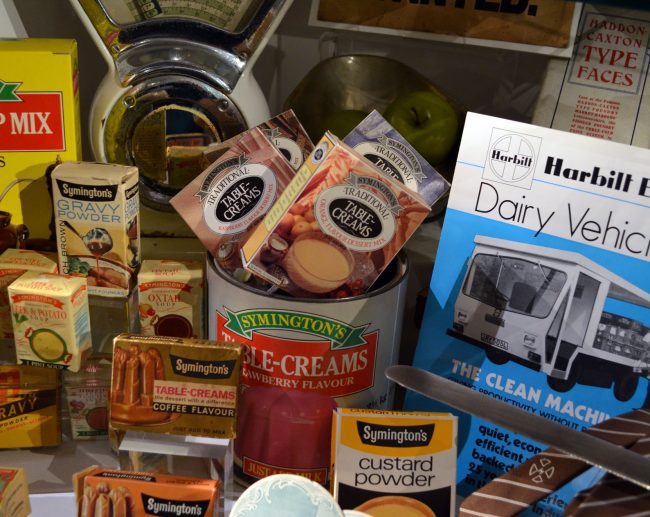
The Liberty Bodice was invented by Fred Cox, Marketing Director at R & W H Symington & Co Ltd in 1908. It was a fleecy knitted vest with rubber buttons, re-enforcing cotton tapes and buttons to attach drawers and stockings. The bodice helped to change the way that children dressed in the early part of the twentieth century.
Until then most middle and upper class children wore supporting re-enforced corsets that were supposed to help ‘train’ their developing bodies. The Liberty Bodice was a softer, less restricting garment that allowed children to move around and play, at a time when playing and being active were viewed as an important parts of childhood.
Fred Cox’s daughter, Freda wore the bodice in an original advertising photograph. She appeared as the ‘Liberty Bodice Girl’ in much of the early marketing. The Liberty Bodice was produced in its millions and continued to be made until the 1960s. Loved or hated by three generations of children it remains one of Leicestershire’s most interesting products.

The Harborough Toys
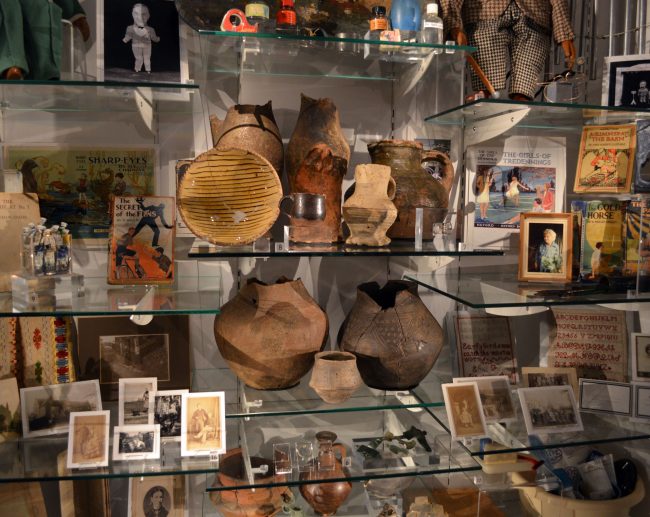
Dating from the early 17th century, a unique hoard of more than 200 toys was found behind a bricked-up stairwell in St. Dionysisus Church in the centre of Market Harborough. The toys include whip-tops, tip-cats, small balls and sap whistles.
They were made from wood, pig’s knuckle bones and fabrics, all easily obtainable materials to children who had to make their own toys long before such things were mass-produced.
Tip-cat, a game where children have to hit a small stick with a bigger stick, has been popular for hundreds of years. It was often seen as a nuisance, even before health and safety rules took the fun out of playground games. As late as 1853 Punch magazine commented ‘This mania for playing at cat is no less absurd than dangerous…’
Could this hoard be confiscated toys taken from children causing trouble around the church more than 300 years ago?
You can read more about toys, including the Harborough Toys, in the Leicestershire Museum Collections website.
Stereoscope
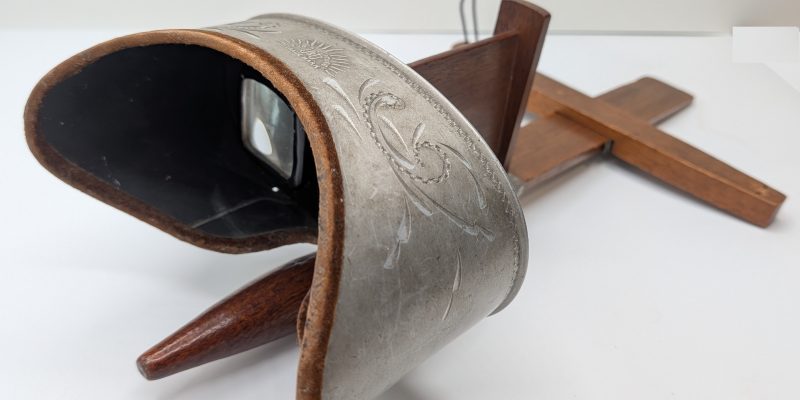
A stereoscopic viewer is an optical instrument which creates a 3D image of a scene.
A stereoscopic camera has two or more lenses, to take two slightly different images of a scene. These are then printed on stereoview cards which are placed in the viewer. Each eye looks at one image, and the brain combines the two images to form a single picture with depth, in a similar way to how our eyes see the world.
It was invented in 1832 by Sir Charles Wheatstone using mirrors and drawings. In 1849 Sir David Brewster replaced the mirrors with lenses. The invention of photography in 1839 helped create scenes for the stereoscope. The popularity of stereoscopes further grew from 1861 when Oliver Wendell Holmes designed a simple handheld version. He deliberately didn’t patent it to encourage mass production.
The museum’s example is a Holmes-style viewer from around 1900, together with stereoview cards of local scenes such as the Old Grammar School and views of the wider world.
Stereoscopes were used as a popular form of home entertainment from the 1850s to 1930s, showing travel destinations, domestic scenes, and for educational use such as historic events, geography and science. Tens of millions of stereoview cards were produced worldwide.
The stereoscope later enjoyed a revival in the 1960s with the “View-Master” children’s toy.
The technology laid the groundwork for today’s 3D images and films, together with virtual reality within gaming.