Living off the land
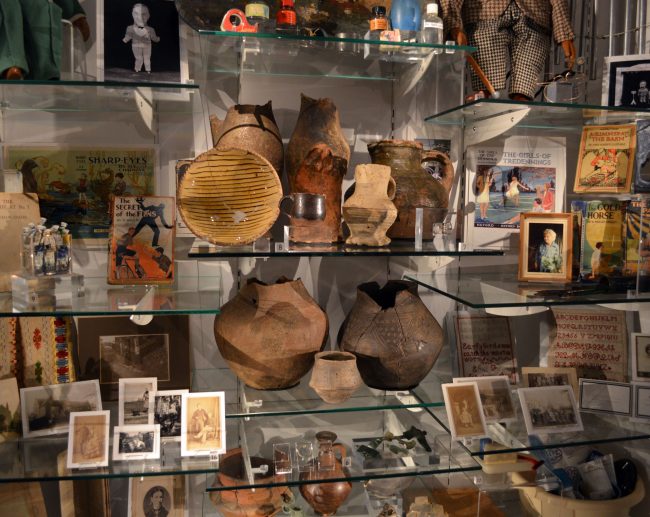
Living off the land is part of the following collections: The Harborough Collection.
Highlights

Standard Imperial Bushel
View object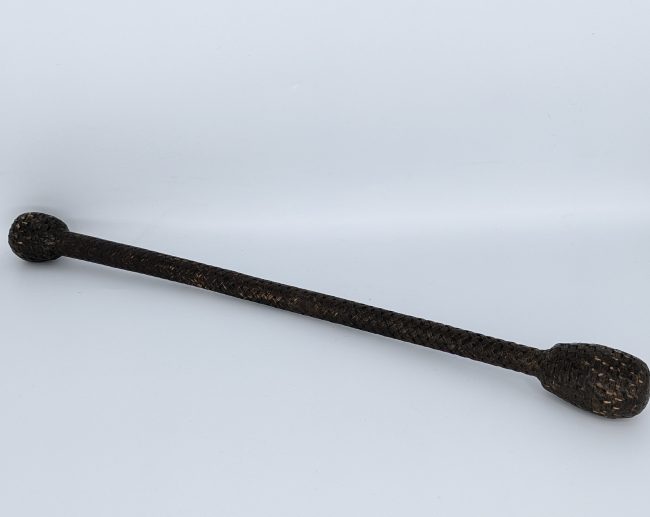
Victorian Leather Cosh
View object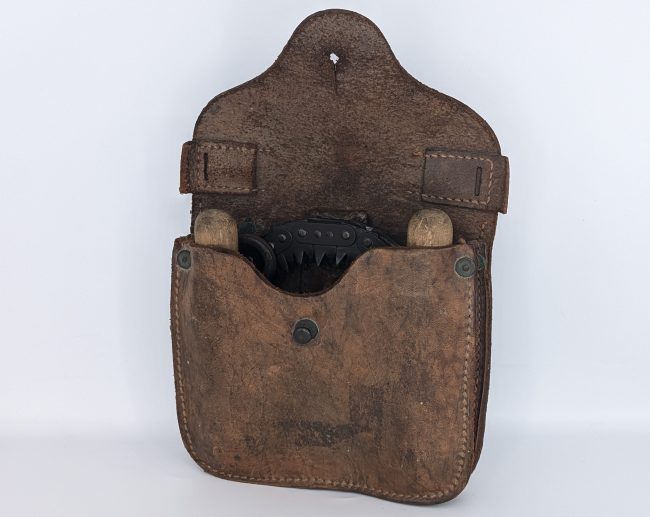
WW2 Folding Saw Set
View object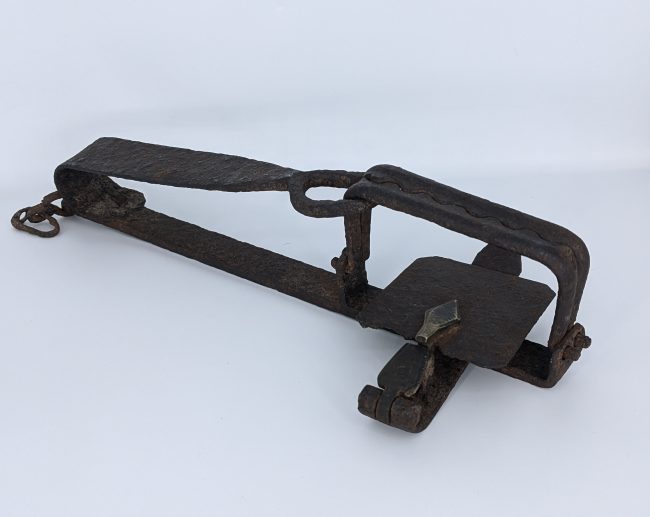
Victorian Rabbit Traps
View object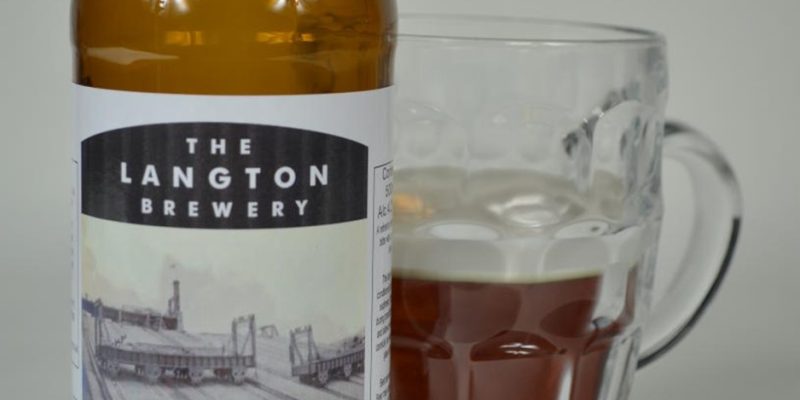
Inclined Plane bottle
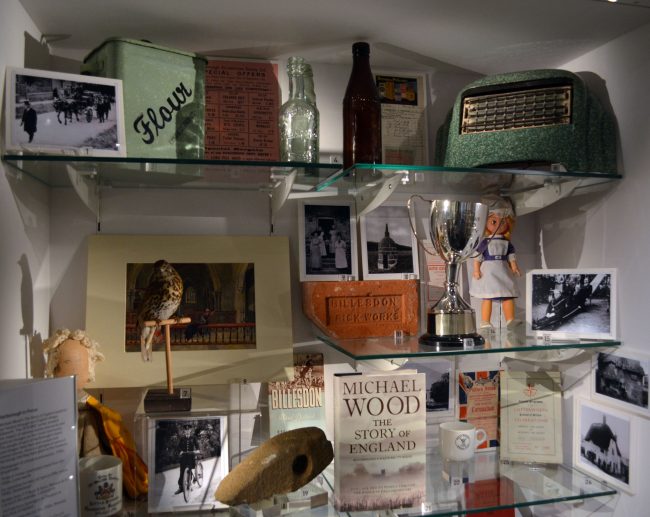
Found in the ‘Living off the Land’ display cabinet in the museum, this bottle of hoppy, straw-coloured ale named after the local landmark at Foxton Locks won the Bronze Award in the Best Bitter category in the Champion Beer of Great Britain Awards in 2014. Brewed at the Langton Brewery since 2004, it uses a North American hop called ‘Amarillo’ which is only grown on six farms in America.
Beer has been an important part of rural life in Britain for many centuries. Besides being one of the staple drinks until improvements were made to the water supply, wouldn’t you really appreciate that refreshing pint after toiling all day in the fields under a hot sun? Before commercial breweries dominated the production of beers and ciders most people drank what was brewed locally.
After almost disappearing, small craft breweries are once again thriving, with their ales tailored to local tastes and celebrating their local communities. The Langton Brewery is just one great example and most of their fifty plus brews are named after aspects of rural life.
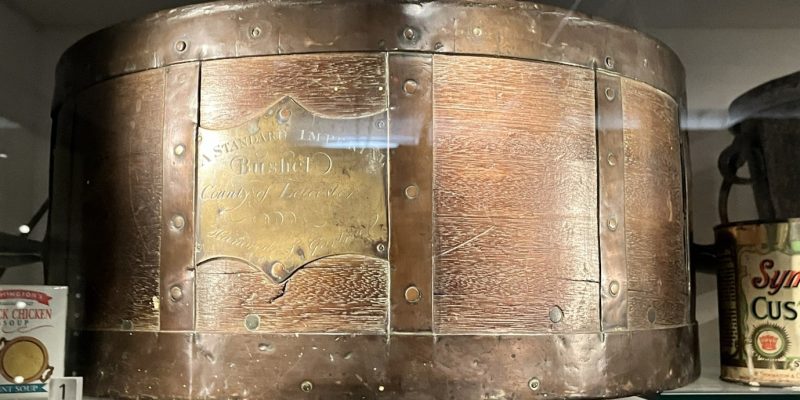
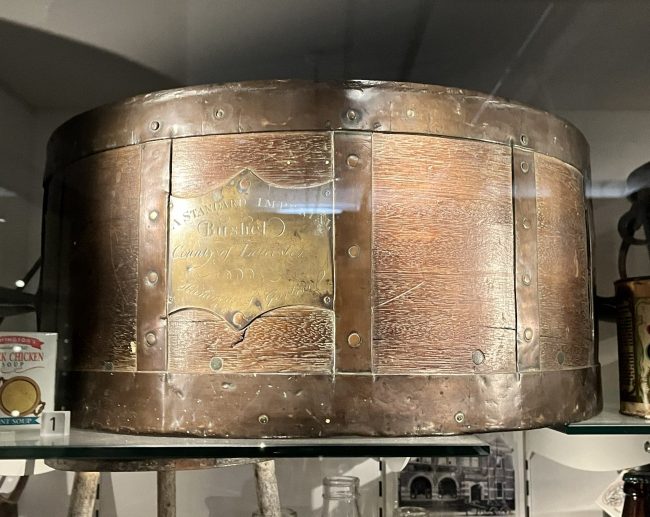
Standard Imperial Bushel
The 1824 Weights and Measures Act standardised the British Imperial system by defining a Bushel as 8 (wine) gallons. The act defined 8 gallons as “containing ten pounds Avoirdupois[1] of distilled water weighed in air at the temperature of sixty-two degrees of Fahrenheit’s thermometer the barometer being at thirty inches…”
The act further defined the gallon as 277.274 cubic inches, making the imperial bushel 2,218.192 cubic inches (approximately 36,350 litres).
This was all well and good but the average trader still had no way of measuring a bushel, so a standard imperial container was made that held exactly one bushel; it would be filled to overflowing and then levelled off across the top, to reach one bushel.
Each region was issued with a standard container and the one on display was for the “County of Leicester”, specifically the “Hundred of Gartree”.
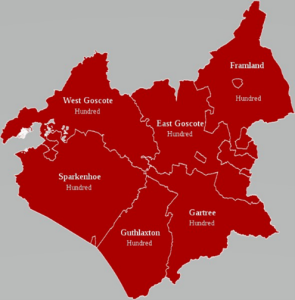
Leicestershire hundreds. Image source: https://www.kibworthvillage.co.uk/museum/item/73-the-gartree-hundred-and-the-gartree-oak.html
A hundred was introduced in Saxon times, between 613 and 1017 and is a unit of English local government and taxation, which in size is between a village and a shire; these survived into the 19th century. Originally, the term referred to a group of 100 hides (units of land required to support one family).
[1] The name derives from the French avoir de pois (“goods of weight” or “property”). The avoirdupois pound contains 7,000 grains, or 16 ounces of 437.5 grains each. The avoirdupois pound has been officially defined as 0.45359237 kg.
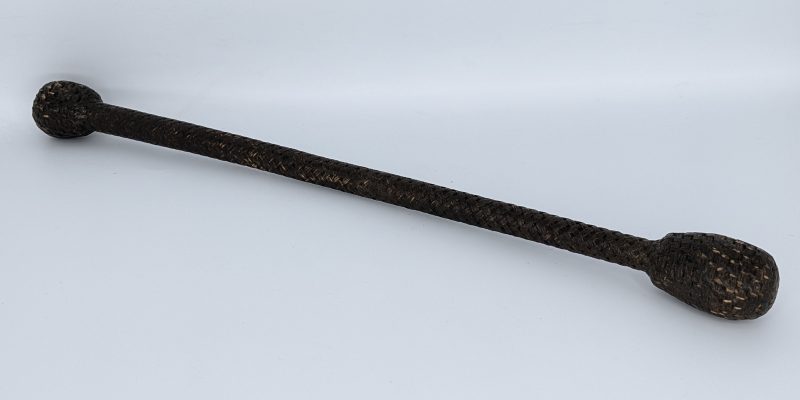
Victorian Leather Cosh
The leather cosh was used to chase away poachers from amongst the Navvies building the Tilton & East Norton Railway, 1879-1880.
Game Acts passed by Parliament made poaching illegal at first during daylight, and later during times of darkness. This was the most common rural crime until the early twentieth century with poaching prosecutions in England peaking in 1877 at just under 12,400 cases.
Between eighty and ninety per cent of poaching prosecutions were for the minor offence of “trespass in pursuit of game during the day-time”, or day poaching which could be dealt with quickly and simply. The high percentage might mean that this was often not a serious, planned crime but one resorted to casually or out of necessity.
This specific cosh is made from split wood covered with plaited alumed leather. Alumed leather has been treated with a naturally occurring mineral salt to make it stronger and more supple. The process also provides light protection against water damage and UV rays that can cause the leather to fade or become brittle.
Poachers often used vicious weapons like this to fight off gamekeepers. This one is weighted with lead at the right-hand end and was probably taken off a poacher by a local gamekeeper.
The term cosh refers to any of several short, easily concealed club weapons and were used as a less lethal alternative to firearms. They can stun or knock a suspect unconscious with a blow to the head.
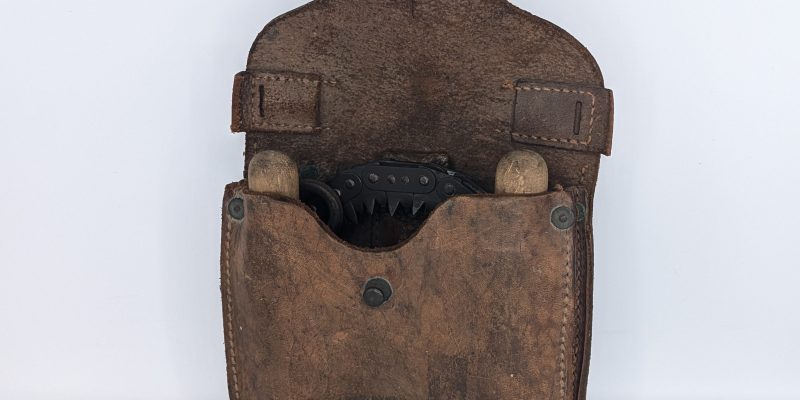
WW2 Folding Saw Set
This folding saw set was manufactured by Disston Saw Works, in Philadelphia, U.S.A. and supplied in 1944. It is 115 cm (46 inch) long and comes with two wooden handles, a saw set and file, all inserted into a military leather belt pouch.
Henry Disston was born in Tewkesbury, England in 1819, and emigrated to the States in 1833.
A Time Magazine article claimed in 1940 that 75 percent of the handsaws sold in the U.S. were made by Disston. During WWII and for about five years after, the company made much of its profit selling steel, not saws.
The folding trench saw is a clever and compact tool which was first introduced into the British Army in October 1907.
A trench saw is a flexible chain with cutting teeth. Each end of the chain has a wooden handle attached. To use it, you throw the chain around a tree or branch, position the teeth where you want to cut, and pull the handles back and forth. This manual sawing motion cuts through the tree. The wood was then used for making props for the sides of trenches.
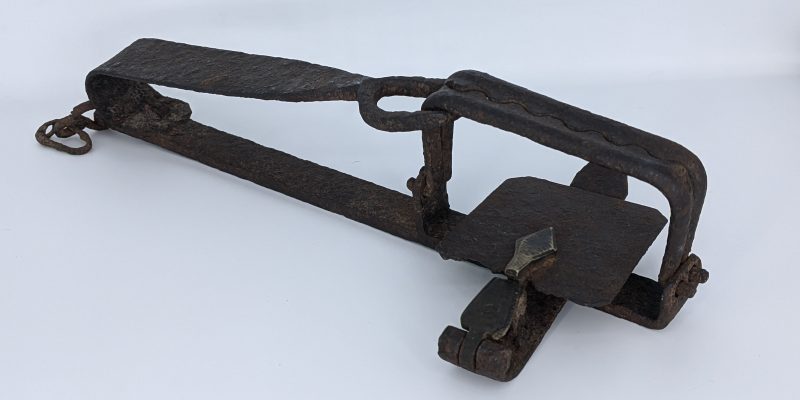
Victorian Rabbit Traps
You can see some examples of 4 inch rabbit traps in the Living off the Land case, known as gin traps. Gin is probably taken from engine, which was used for automatic machines.
This was a reliable trap and simple to use. The ‘jaws’ of the trap closed quickly when the plate was stepped on, powered by a spring.
The two diagrams below illustrate the component parts of a typical gin trap.
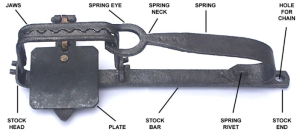
Diagram 1: The component parts of a typical gin trap
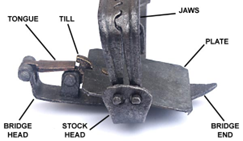
Diagram 2: Detail of the trap’s trigger mechanism
Trappers would need to hide the trap under some earth near the entrance to a burrow to capture rabbits as they came out.
Gin traps have been illegal to use in England and Wales since 1958 following the passing of the 1954 Pests Act.
They remained lawful in Scotland until April 1973.
Diagrams courtesy of Andrew Westcott: Introduction To The British Gin Trap. Available at https://www.qsl.net/2e0waw/gintraps.htm